What It Actually Costs to Replace a Furnace in Denver in 2026 and the Financing Traps to Avoid
Price ranges from three contractor tiers, the CPD permit fee nobody quotes you, and how to get a fair deal when your heat goes out in October.

Price ranges from three contractor tiers, the CPD permit fee nobody quotes you, and how to get a fair deal when your heat goes out in October.
The October Crunch Makes This Decision Different
Denver’s heating season doesn’t ease in. The first sustained hard freeze typically lands between October 12 and October 20, and when it does, HVAC dispatch lines light up across the metro at roughly the same moment. By the second week of October, most of the established players—Applewood Plumbing, Heating & Electric, Brothers Plumbing Heating and Electric, and the franchise outfits running Carrier and Lennox flags in the suburbs—are booking two to four weeks out for non-emergency installs.
Same-day emergency slots exist. They carry documented surcharges of $150 to $300 above standard pricing, and they come with a very different negotiating climate than a July replacement.
October is precisely when high-pressure contractor tactics work best. A family with no heat, overnight lows in the twenties, and a contractor standing in the basement with a financing tablet is not in a position to make a good decision. This piece exists to front-load what you need before that moment arrives—or in the first hour after it does.
If your furnace died this morning: yes, replace it. A functioning heating system isn’t optional in a Denver winter. The rest of this covers what it costs, what the permit adds, whether a heat pump makes financial sense for your specific house, and which financing offer on the contractor’s iPad to decline.
What Furnace Replacement Actually Costs in Denver—By Contractor Tier
Installed prices in Denver vary more by contractor category than by equipment brand. This is the single most useful thing to know before you start calling around, and competing cost guides almost never acknowledge it. Here’s what the market looks like in October 2026, broken across three categories.
Large Franchise Operators (Applewood, Brothers, and similar)
These companies carry Carrier, Lennox, and Trane equipment and employ in-house comfort advisors who handle sales separately from technicians. You’re paying for that overhead. Installed costs for a standard single-stage 80 AFUE gas furnace—typically 60,000 to 80,000 BTU nominal for a 1,400 to 2,000 square foot Denver home—run $4,200 to $6,500.
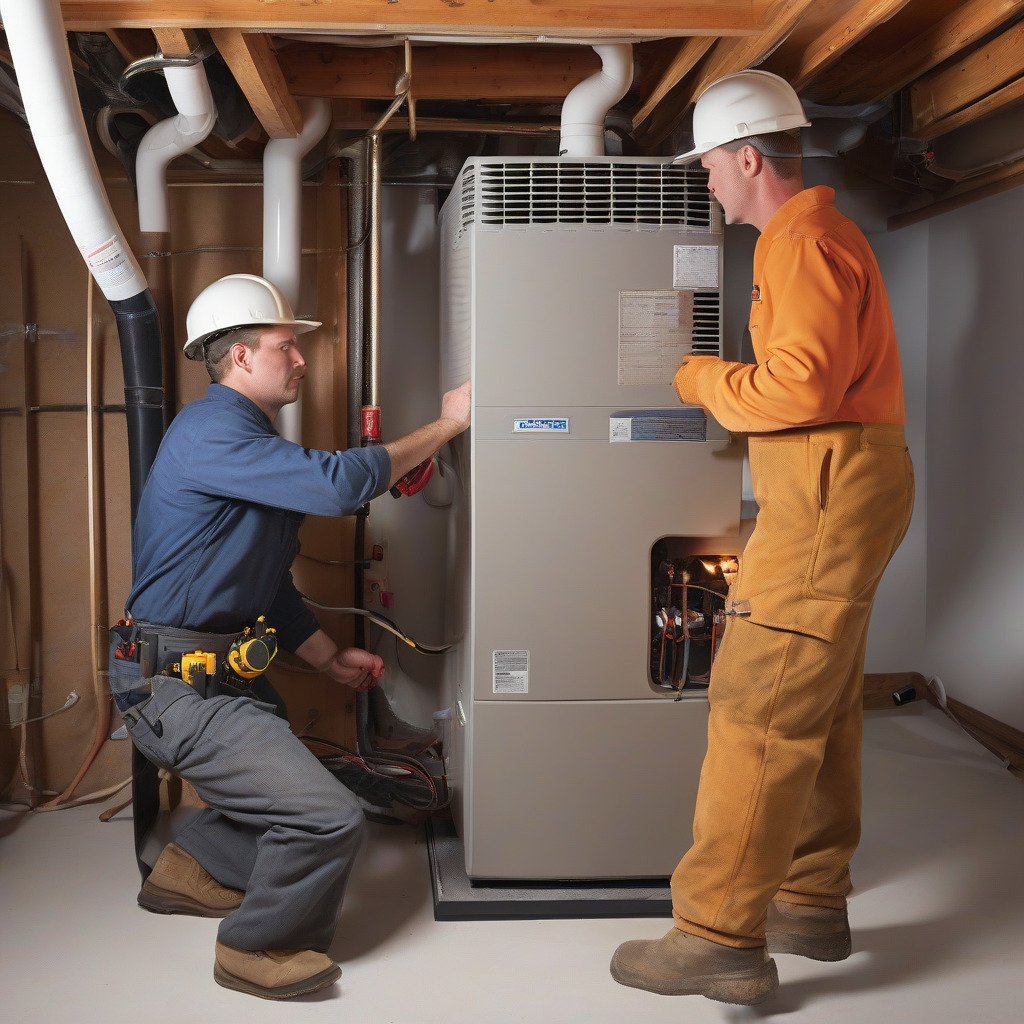
A two-stage or modulating 96 AFUE high-efficiency unit from the same outfits costs $5,500 to $8,500 installed, reflecting both the equipment premium and additional labor for PVC venting and condensate drainage. These companies have large parts inventories and 24-hour dispatch. If your heat dies at 11pm in January, that infrastructure matters. You’re paying for it either way.
Mid-Size Local Independents (Denver Proper, Englewood, Arvada)
This tier—contractors with three to eight trucks, owner-operators who may actually show up on the estimate, established relationships with Rheem, Ruud, and York distributors—prices noticeably below the franchises. Installed 80 AFUE gas furnace: $3,400 to $5,200. A 96 AFUE unit: $4,500 to $6,800.
The equipment at this tier isn’t inferior. Rheem and Ruud share a manufacturing parent with comparable quality standards to the big brands. What you’re not paying for: no showroom, no branded uniforms, no comfort advisor layer. In practice, these contractors are often easier to actually talk to, and their scheduling tends to be more flexible outside of peak crunch weeks.
Independent Shops in Aurora and Lakewood
Smaller owner-operated contractors along the I-225 corridor and the western suburbs represent the biggest price gap in the Denver market—one that national cost guides almost entirely ignore. Installed 80 AFUE pricing: $2,900 to $4,400. Installed 96 AFUE pricing: $3,800 to $5,800.
The 15 to 25 percent difference between this tier and franchise pricing is real. The tradeoffs: smaller crews that can get stretched thin when demand spikes in October, potentially shorter parts-on-hand inventory, and warranty service that depends on a smaller operation staying in business.
For a homeowner who isn’t in a panic and has a few days to vet references, this tier is worth pursuing. For a household with no heat and a hard freeze arriving tomorrow night, a mid-size local company is probably the better balance of price and reliability.
One thing to verify regardless of tier: Every quote should include equipment, standard installation labor, removal and disposal of the old unit, and the CPD mechanical permit. Verify this before the contractor leaves your house. Some franchise quotes build the permit in; some independent shops quote equipment-plus-labor and list the permit as a separate item or skip it entirely. Ask directly, every time.
The Denver Altitude Factor Nobody in Your Estimate Will Mention
At 5,280 feet, Denver sits high enough that altitude meaningfully affects every gas appliance in the house. The principle is straightforward: gas combustion efficiency decreases as air density decreases, and the accepted adjustment for gas appliances is roughly 4 percent per 1,000 feet above 2,000 feet in elevation. Denver sits 3,280 feet above that threshold, which means your appliances lose approximately 13 percent of rated output.
In practical terms: a furnace labeled at 100,000 BTU nominal delivers closer to 88,000 to 90,000 BTU in your basement. If a contractor sizes your replacement using flat national BTU tables with no altitude adjustment, you may end up with a unit that can’t keep pace with a sustained cold snap—and Denver gets several per winter, the kind that hold lows in the single digits for three consecutive nights.
Proper sizing requires a Manual J residential load calculation: a room-by-room heat loss analysis accounting for window area, insulation values, ceiling height, air infiltration, and local design temperature. A correct Manual J incorporates altitude adjustment. The City and County of Denver’s Community Planning and Development (CPD) requires that equipment be appropriately sized for the structure, and the post-installation inspection can flag egregious mismatches. But the inspection isn’t a substitute for doing the math before installation.
Ask every contractor directly: “Is this BTU sizing based on a Manual J adjusted for Denver’s altitude?” A contractor who can’t answer that question is guessing.
The CPD Mechanical Permit—Required, Not Optional, and Here’s What It Costs
Denver requires a mechanical permit for every furnace replacement. No exceptions for like-for-like swaps, no exemptions for older equipment. This is a legal requirement under the Denver Building and Fire Code, which adopts the International Mechanical Code with local amendments.
The CPD fee schedule—available at denvergov.org/permits—bases residential mechanical permit fees on the valuation of the work. For a typical residential furnace replacement, the total permit cost including the required post-installation inspection has run $100 to $180. Verify the current fee before your contractor quotes by checking denvergov.org/permits or calling CPD at 720-865-2715; the schedule is updated periodically.
Permits are pulled through CPD’s MyPermitNow portal at permits.denvergov.org. The licensed mechanical contractor should pull the permit in their name before work begins, not after. A CPD mechanical inspector then verifies venting, gas line connection, combustion air, and basic code compliance.
An unpermitted system creates real problems at resale. Colorado real estate disclosure law requires sellers to disclose known material defects, and a furnace installed without a permit qualifies. As our home and property coverage documents across multiple inspector interviews, title companies and buyer’s lenders increasingly request permit records during transactions. And if you ever file a homeowner’s insurance claim related to a fire or carbon monoxide event and the system was installed without a permit, your insurer has a documented basis to dispute it.
What Denver home inspectors flag most often includes unpermitted mechanical work—and furnace replacements are among the most commonly discovered violations during pre-sale inspections. Before releasing final payment, search your property address at denvergov.org/permits. The record is publicly searchable and should show the permit number, the contractor of record, and inspection status. If the permit isn’t there, hold the final payment until it is. A legitimate contractor won’t argue with you about this.
Gas Furnace or Heat Pump—The Rebate and Tax Credit Math in One Place
The right answer here depends on your specific house in ways no article can fully resolve. Heat pumps have improved substantially for cold climates, and the financial incentives available in 2026 change the arithmetic compared to three years ago. But the math isn’t uniformly favorable, and the single biggest variable is usually the one that gets left out of the first conversation.
Installed cost for a cold-climate heat pump in Denver runs $8,000 to $14,000, depending on equipment tier and system configuration. That assumes existing ductwork in serviceable condition. It doesn’t assume an electrical panel upgrade—which is where the real cost hides.
Denver’s older residential neighborhoods—Capitol Hill, Park Hill, Sunnyside, West Highland—contain substantial housing stock with 100-amp or older panels. A heat pump requires a 240-volt dedicated circuit and, depending on what else runs in the home, may require upgrading to 200 amps. That adds $1,500 to $4,000 to the project. If you live in a 1920s bungalow in Sunnyside and a contractor quotes you a heat pump without mentioning your panel, ask directly before he leaves.
The savings stack starts with Xcel Energy rebates. For a 96 AFUE or higher gas furnace, Xcel’s current rebate is $150 to $300 depending on BTU capacity and what it replaces. For a cold-climate air-source heat pump meeting NEEP specifications, Xcel’s rebate runs $300 to $1,200 depending on efficiency rating and capacity. Verify current amounts at xcelenergy.com/rebates before your contractor quotes—tiers adjust annually and occasionally mid-year when funding runs low.
The IRA Section 25C Federal Tax Credit covers 30 percent of installed cost, up to $600, for a qualifying 96 AFUE or higher gas furnace. For a qualifying heat pump, the cap rises to $2,000. Confirm the current status of the 25C credit at IRS.gov before signing anything; this credit has been subject to legislative changes.
Two worked examples. A $6,000 installed 96 AFUE gas furnace nets to roughly $5,250 after an Xcel rebate of approximately $150 and a 25C credit of $600 (the cap). An $11,000 installed cold-climate heat pump—panel already adequate—nets to roughly $8,300 after a $700 Xcel rebate and a $2,000 25C credit. Add a $1,500 to $4,000 panel upgrade for older Capitol Hill housing stock and the gap widens further. It narrows only over time through lower operating costs, and only if electricity-to-gas pricing ratios hold favorable, which is not guaranteed.
Two things worth knowing before you sign a heat pump contract. The 25C credit is non-refundable—it reduces your federal tax liability dollar-for-dollar but doesn’t generate a refund if your liability is lower than the credit amount. If you owe $400 in federal taxes after other credits, you capture $400, not $2,000. Also, rebate payments from Xcel may be considered taxable income, which reduces their effective value for higher-bracket taxpayers. Both points warrant a conversation with your accountant.
The heat pump decision ultimately comes down to your panel, your tax situation, how long you plan to stay in the home, and your appetite for contractor coordination complexity during a cold-snap emergency. For most homeowners in Park Hill or Whittier with older panels who aren’t planning to stay long-term, the gas furnace math is likely cleaner. For someone in a newer Stapleton build planning to stay a decade, the heat pump deserves serious evaluation.
The 96 AFUE Upgrade—Whether the Premium Pays Off in Denver’s Climate
For homeowners who’ve decided on a gas furnace and are comparing 80 AFUE mid-efficiency against 96 AFUE high-efficiency, Denver’s climate makes this more consequential than the same decision in Dallas. Denver averages roughly 155 heating days per year. Efficiency differences compound across that many hours of runtime in ways that barely register in mild climates.
The 16-percentage-point efficiency gap means the high-efficiency unit captures significantly more of the fuel’s heat value. Xcel’s natural gas rates—which fluctuate—combined with the Xcel rebate narrow the upgrade payback period. The specific math depends on your home’s heat load, but for a household expecting to stay put for at least five years, the 96 AFUE is worth pricing seriously.
There are retrofit costs that don’t always surface in the initial quote. A 96 AFUE furnace condenses combustion gases, which requires PVC venting rather than the metal flue pipe a mid-efficiency unit uses. If your existing home has a metal B-vent that previously served only the furnace, that flue now becomes dedicated to the water heater or gets capped. The PVC vent termination through a wall or rim joist is a separate labor item. A 96 AFUE unit also requires a condensate drain line—run to a floor drain or, in basements without a nearby floor drain, via a condensate pump. These two additions typically cost $200 to $600 depending on how far the condensate needs to travel and whether the venting penetration requires masonry work.
Ask whether those are included in the quote before anyone starts working.
If you’re selling in three years, the upgrade math is harder to justify. If you’re staying, run the numbers with the retrofit costs included.
The Financing Traps Denver HVAC Companies Offer—and What to Insist On Instead
The most dangerous thing a Denver contractor will hand you in an emergency is a tablet with a financing offer already calculated, framed like a formality. It isn’t.
The dominant financing products offered by Denver’s major HVAC franchises are administered through GreenSky and Service Finance Company. Both commonly offer what gets presented as “18 months same as cash” or “0% for 18 months.”
These are not 0% loans. They’re deferred-interest products. Interest accrues at the full APR—typically 26.99%—during the promotional period but is waived if you pay the full balance before the deadline. If one dollar remains on the balance at month 18, the lender applies all accrued interest retroactively to the original principal from day one. Every dollar of interest that accumulated while you thought you were paying nothing gets added back to what you owe. This is not fine print—it’s the core mechanic of the product, and it’s how these programs generate profit on customers who almost pay on time.
Three safer alternatives specific to Denver and Colorado:
Xcel Energy On-Bill Financing lets you finance qualifying energy-efficiency equipment—including high-efficiency furnaces—repaid through your monthly Xcel bill. Historical rates have run 0 to 3 percent. There’s no deferred-interest structure, and the payment appears on a bill you already review every month rather than a separate account that can drift out of attention. Confirm availability and current terms at xcelenergy.com or 1-800-895-2999.
The Colorado Energy Office RENU loan program (Residential Energy Upgrade) is administered through participating lenders at fixed rates historically in the 3 to 6 percent range, with no prepayment penalty. These are true amortizing loans—your payment is fixed, the balance declines every month, no retroactive interest trap. The application takes a few days, which makes RENU better for pre-planned replacements than emergencies, but worth knowing if you have any lead time. Check current program status at energyoffice.colorado.gov.
Lower-income homeowners may qualify for subsidized or grant-funded heating system replacement through Denver Human Services’ weatherization and emergency heating programs or through Mile High United Way’s 211 referral network. These are not loans. Call 211 to check eligibility before taking on any debt for a furnace if income could be a qualifying factor.
One more to watch: PACE financing (Property Assessed Clean Energy) attaches repayment to your property as a special assessment rather than to you personally. PACE assessments can complicate mortgage refinancing and resale—lenders may require the assessment paid off at closing. If you’re within a few years of selling or refinancing, decline it.
How to Get a Fair Quote When Your House Is Already Cold
Go to the furnace before you call anyone. Read the nameplate—usually a sticker on the inside of the cabinet door or on the heat exchanger housing. Note the brand, model number, BTU input rating, and AFUE rating. Photograph it.
This lets you give contractors enough information for a meaningful phone estimate without requiring an in-person visit first. That buys you competitive comparison time, which is the only leverage you have in an emergency.
When you call, ask three questions before anyone arrives: Does the quoted price include the CPD mechanical permit and inspection? What is the exact brand and model number of the unit you plan to install, and what is its AFUE? What are the full terms of any financing offered—APR, term length, and what happens if the balance isn’t paid before the promotional period ends?
A company that hedges on any of those over the phone isn’t prepared to give you a reliable quote.
If you need to buy time, a $40 to $80 electric space heater from the Home Depot on Colorado Boulevard or the one on Federal Boulevard can keep a bedroom livable overnight. This is not a permanent solution and shouldn’t run unattended, but it can give a household with children or elderly members the margin to get two or three quotes instead of one. That margin is worth more than it sounds at 9pm when you’re staring at a dead furnace.
If you suspect a gas line or meter issue rather than a failed furnace, call Xcel’s emergency line first at 1-800-895-2999, available 24 hours. Xcel will dispatch a technician at no charge to determine whether the problem is at the meter or gas line—their responsibility—or inside your home, which is yours. Paying a contractor to diagnose a meter issue is a completely preventable expense.
Before releasing final payment, search your address at denvergov.org/permits. The permit should appear before or immediately after installation, not two weeks later. If it’s absent, hold the final payment and ask for the permit number. A licensed contractor won’t object.
Seven Questions to Ask Any Denver HVAC Contractor Before You Sign
1. Does the price include the CPD mechanical permit and inspection?
If no, add $100 to $180 and ask why it was excluded.
2. What is the exact brand, model number, and AFUE of the equipment being installed?
“A high-efficiency Carrier unit” is not an answer. Get the model number and look it up.
3. Is the BTU sizing based on a Manual J load calculation adjusted for Denver’s altitude?
Denver’s elevation requires an adjustment that many contractors skip. A correct Manual J accounts for it. If the contractor looks blank, that’s information.
4. What are the full financing terms—APR, term length, and what happens to accrued interest if the balance isn’t paid before the promotional period ends?
This question exposes whether you’re being offered a deferred-interest product. If retroactive interest applies, use Xcel on-bill financing or a RENU loan instead.
5. Is this a deferred-interest product or a true 0% loan?
Ask it directly even after question four. The sales presentation is deliberately worded to blur the distinction.
6. What are the warranty terms on equipment and on labor, separately?
Equipment warranties (typically five to ten years on heat exchangers) and labor warranties (which range from 90 days to two years depending on the contractor) are separate instruments. Both matter. Get both in writing.
7. Can you provide references from installations in my neighborhood in the last 12 months?
A contractor with no local references in your part of the city isn’t automatically disqualified—but the answer tells you something about how deep their service history runs in your area, and about their confidence in the work.
CityDesk Denver covers local business, infrastructure, and consumer issues for Denver residents. Furnace price ranges in this article were gathered from contractor quotes and published fee schedules current as of October 2026. Rebate and tax credit figures reflect program terms as of publish date; verify current amounts directly with Xcel Energy at xcelenergy.com or 1-800-895-4999, and confirm federal credit status at IRS.gov, before making a purchasing decision.