Refinish or Replace That Old Denver Bathtub? Here's the Local Math That Actually Matters
From Harvey Park ranch homes to Capitol Hill apartment buildings, bathtub refinishing is having a moment across metro Denver. Here's the local math, the real safety picture, and what to ask before …

From Harvey Park ranch homes to Capitol Hill apartment buildings, bathtub refinishing is having a moment across metro Denver. Here’s the local math, the real safety picture, and what to ask before you hire anyone.
Denver’s housing market has a texture problem. Beneath the quartz countertops and open-concept renovations of the city’s fix-and-flip era, there are bathtubs. Steel and cast-iron originals from the Eisenhower years. Porcelain fixtures installed before World War II. Surfaces worn down by decades of Denver water, cleaning products, and tenants who ignored the maintenance instructions. Whether to refinish or replace them is a more consequential call than it looks, because the wrong answer costs you either money you didn’t need to spend or a coating job that’s peeling by spring.
Denver’s Housing Stock Created This Problem
The residential boom that followed World War II built out Harvey Park, Barnum, Montbello, Park Hill, and Westwood in a compressed window — roughly 1945 to 1975. Those neighborhoods share a common infrastructure: small lots, single-story ranch plans, and original bathroom fixtures that are now between 50 and 80 years old. The steel and cast-iron tubs installed in those homes were built to last, and they have. That’s actually the problem. Structurally sound, but etched, stained, and worn through the original porcelain enamel to the point where they look neglected even in an otherwise updated bathroom.
Capitol Hill, Cheesman Park, and the dense apartment corridors of Congress Park present a different vintage of the same issue. The brick walk-ups that define those blocks have porcelain-on-cast-iron tubs approaching a century old. Many of those fixtures are genuinely beautiful under the grime. Many are also the source of ongoing maintenance headaches for landlords who can’t decide whether patching the surface one more time is smart or just postponing the inevitable. A good refinisher will tell you honestly which situation you’re in before taking your money. Not all of them do.
The city’s active investment market has sharpened the decision point. Flippers working inner-ring neighborhoods face it at closing. Property managers running mid-size rental portfolios in LoHi and RiNo face it between tenants. Single-unit landlords in Baker face it when a move-out inspection reveals a tub that photographs badly on Zillow. Aging supply plus rising contractor costs has turned what used to be a maintenance afterthought into a real line-item decision.
What a Professional Refinishing Job Actually Involves
Before signing anything, you should know what a refinisher is actually doing in your bathroom. The process is more involved than most homeowners expect — and if a contractor’s pitch sounds suspiciously quick and easy, treat that as information.
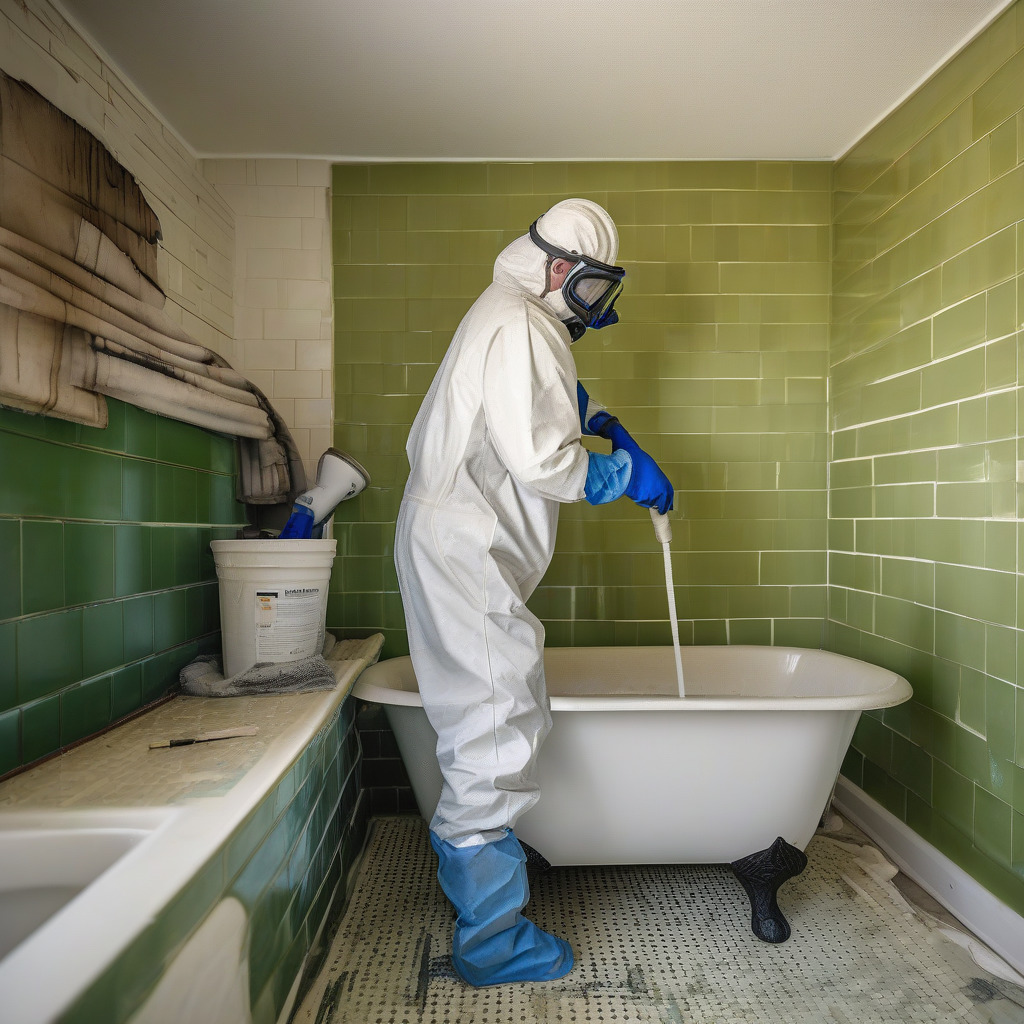
A professional job begins with thorough chemical cleaning of the entire tub surface. Soap scum, mineral buildup, residue from previous products — all of it has to go. This matters in Denver specifically because of the water chemistry, which we’ll get to in a moment. After cleaning, the technician etches the existing surface with an acid-based compound to create a mechanical bond for the new coating. Etching is what distinguishes refinishing from a paint job. Without adequate surface profile, any coating applied over smooth porcelain or fiberglass will peel. It’s not a question of if.
Next comes a primer layer formulated to bridge the old surface and the new topcoat. The topcoat itself is typically a urethane or epoxy-based coating, sprayed in multiple passes using professional HVLP equipment. Consumer aerosol cans can’t replicate this — the application quality isn’t in the same category. The spray work requires masking off the surrounding area — walls, floors, fixtures, ventilation openings — to contain overspray, and the technician works in a sealed space under conditions that become significant when you factor in Denver’s elevation.
A standard residential job runs three to six hours from setup to final inspection, most of that weighted toward prep. The finished surface needs a full day, sometimes two, to cure before the tub can be used, and off-gassing from the coatings continues during that window. Tile surrounds can be refinished at the same appointment, which makes it possible for a bathroom to look genuinely updated rather than having a bright new tub surrounded by 1960s avocado tile. Renew-It Refinishing, which operates in the Denver market, is among the contractors that offer combined tub-and-tile appointments — a scheduling detail worth confirming with any refinisher you’re evaluating, since not all do.
What Refinishing Actually Costs in Denver Right Now
The national benchmark of $300 to $650 is not a useful number for Denver homeowners. The labor market here has tightened considerably, and trades work reflects that directly.
A standard residential bathtub refinishing in metro Denver currently runs $400 to $750 for the tub alone, depending on surface condition, fixture size, and coating system. Add a tile surround and figure another $200 to $500 depending on square footage and tile condition.
Full replacement costs substantially more. Swapping out an alcove tub — the standard configuration in most Denver ranch homes and apartment bathrooms — is not a simple fixture swap. It involves demolition, potential subfloor assessment, plumbing disconnection and reconnection, tub installation, and tile or surround work. In the current Denver contractor market, that scope starts around $1,500 for a bare-bones replacement with a builder-grade tub and prefab surround. It escalates quickly to $4,000 or more if tile work, plumbing complications, or permits enter the picture. Cast-iron removal alone adds significant labor: those tubs weigh 300 to 500 pounds, and getting one out of a Capitol Hill walk-up is not a quick job.
The math favors refinishing when the underlying fixture is structurally sound — no cracks through the substrate, no soft spots in fiberglass, no rust penetrating through cast iron. Refinishing a tub in poor structural condition isn’t a solution. A reputable refinisher will tell you this before taking your money. One who doesn’t is worth walking away from. For a broader look at what Denver home inspectors flag most often when evaluating older fixtures and structural condition, that reporting is worth reading before any major bathroom decision.
The Altitude Factor Is a Real Safety Issue
Here’s the variable that most refinishing content ignores entirely, and that Denver residents have a specific reason to understand. At 5,280 feet, atmospheric pressure is roughly 12 percent lower than at sea level. That pressure difference has a direct effect on how VOC-containing solvents in refinishing coatings behave inside an enclosed space. This isn’t a footnote. It’s the reason Denver residents should ask questions that homeowners in Chicago or Phoenix don’t need to raise.
Lower atmospheric pressure causes volatile organic compounds to evaporate and off-gas at a faster rate. In practical terms: the same coating applied in a Denver bathroom will reach peak off-gassing concentration faster than it would at lower elevation. Ventilation protocols developed for the refinishing industry at sea level are not automatically adequate at Denver’s altitude.
This matters most in older Denver homes — exactly the housing stock where refinishing is most commonly considered. Ranch homes in Harvey Park and Barnum were built with minimal bathroom ventilation. Capitol Hill apartment bathrooms present similar constraints. In those spaces, inadequate ventilation during and after a coating application can result in VOC concentrations that exceed safe occupancy levels for longer than most technicians will mention unprompted. The information exists, the chemistry is well understood, and it rarely comes up unless you ask. That gap is worth being direct about when you’re making calls.
The Colorado Department of Public Health and Environment’s Air Pollution Control Division maintains standards governing VOC emissions in commercial coating applications. Residential refinishing occupies a gray zone of that regulatory framework, but the underlying chemistry isn’t in dispute. When you call potential contractors, ask what the VOC rating is for the specific coating they use. Ask what ventilation equipment they bring beyond what exists in your bathroom. Ask whether they’ve adjusted their ventilation protocol for Denver’s elevation. A contractor who goes blank when you raise altitude as a variable is telling you something about their operational rigor.
Denver Water and Why Surface Prep Is the Whole Game
Denver Water delivers moderately hard water across most of the metro — minerals dissolved from Colorado’s geology that accumulate visibly on tub surfaces over time. The scaling around faucets and along the waterline of an older tub is mineral buildup, and it’s a serious impediment to coating adhesion if not fully removed before refinishing. This is arguably the single most important variable in whether a refinishing job holds up, and it’s the one most likely to be rushed.
A coating applied over residual mineral deposits — even deposits that look minor or are invisible — bonds to the mineral layer rather than the substrate. When that mineral layer eventually lifts, the coating goes with it. Denver’s water chemistry makes the prep challenge more demanding here than in softer-water markets. Proper mineral deposit removal requires acid treatment and mechanical preparation that goes well beyond cleaning. A refinisher who isn’t explicitly accounting for hard-water buildup in their prep protocol is skipping a step that this city’s water supply makes mandatory.
Ask directly: How do you address mineral deposits before application? What products do you use, and how do you verify the surface is clear before applying bonding agent? Vague answers are a red flag. Specific ones are reassuring.
How Long a Refinished Tub Actually Lasts
The “2 to 10 years” figure that appears in most refinishing content is technically accurate and completely useless. That range spans everything from a careless DIY application on an unprepped surface to a professional coating on properly cleaned cast iron with careful ongoing maintenance. It’s the kind of number that sounds like information but isn’t.
Professional-grade urethane and epoxy coatings differ from consumer kits in chemistry, adhesion characteristics, and cure quality under controlled conditions. Coating quality sets the ceiling on durability. Surface prep quality sets the floor. A high-quality coating on inadequate prep will fail faster than a modest coating on perfect prep — which is why the mineral deposit question matters so much in Denver specifically.
Post-service maintenance determines where a given job lands. Refinished surfaces are durable but not indestructible, and the specific way they fail is abrasion. Abrasive cleaners — powders, scrubbing pads, anything with grit — will cut through the topcoat over time. Suction-cup bath mats with adhesive backing are a similar problem; the cups trap moisture against the surface and create localized adhesion failures when removed. Liquid cleaners, soft cloths, no scrub brushes. No exceptions and no gray area there. Ask any refinisher you’re evaluating to walk you through their durability expectations for your specific fixture, your water, and your bathroom’s use patterns. How they answer tells you a lot about whether they actually know what they’re doing.
What Denver Landlords and Property Managers Should Know
The calculus for investment property owners is distinct from the homeowner decision, and the differences are worth understanding clearly.
The most immediate argument is turnaround time. A full tub replacement in a tenant-occupied building requires scheduling demo, plumbing disconnection, tub removal, installation, and finish work — a multi-day scope that renders a unit uninhabitable throughout. A refinishing job runs one day, with a day or two of cure time before the unit is ready. For a landlord managing occupied buildings in Capitol Hill or LoHi, the difference in carrying cost is real, and the difference in tenant relations can matter even more.
There’s also a compliance dimension Denver landlords shouldn’t overlook. Denver’s Healthy Homes rental housing ordinance, effective 2019 and amended since, establishes habitability standards that touch on the condition of sanitary facilities. A visibly degraded tub surface can become an inspection issue. Verify the specific requirements with Denver Community Planning and Development, but refinishing a tub before it becomes an enforcement issue is both a maintenance decision and a risk management one. Getting ahead of it is cheaper than dealing with it after. Understanding what Denver tenants can do when landlords delay repairs is a useful counterpart to reading the landlord side of this calculus — both parties benefit from knowing the same compliance baseline.
Volume pricing is worth pursuing for property managers running multiple units. Refinishers who work the commercial and multifamily market will negotiate per-unit rates for landlords who can offer recurring work or multi-unit projects. The logistics of mobilizing equipment across several units in the same building create real efficiencies. Ask directly what a volume or recurring-client arrangement might look like. Most contractors would rather have predictable work than chase one-off jobs.
An Honest Look at DIY Refinishing in Denver
Consumer-grade refinishing kits are available at Home Depot. They work — under specific conditions worth understanding before you commit a Saturday to this project.
Consumer kits use different chemistry than professional coatings and apply with a brush or roller rather than a spray system. The surface texture is different, cure time is longer, and the durability ceiling is lower. Under ideal conditions — clean, lightly worn surface, correct application temperature, proper cure time, careful ongoing maintenance — a consumer kit produces a functional result for a homeowner on a tight budget who’s realistic about performance expectations. Don’t expect it to look like a professional job, and don’t expect it to last as long. It can buy you time. That’s about it.
Where DIY falls short in Denver specifically is on the two variables this article keeps returning to: surface prep and ventilation. Consumer kit instructions don’t account for hard-water mineral buildup as a prep consideration. The off-gassing issue at elevation is, if anything, more acute with consumer products applied in a sealed bathroom by someone without professional ventilation equipment — longer application time, less controlled ventilation, no altitude-adjusted protocol, no professional respirator. That combination in a sealed older bathroom is genuinely worth taking seriously before you decide the kit is good enough. The altitude dimension makes the professional-versus-DIY gap wider here than in lower-elevation markets, and that gap has safety implications, not just quality ones. My honest read: if you’re in a Capitol Hill apartment bathroom with one small window, skip the kit.
What to Ask Before Hiring Any Refinisher in Denver
These questions separate professional operations from marginal ones. Don’t skip them because the person on the phone sounds confident.
Start with licensing and insurance. Does the business carry general liability coverage and required business licenses in your municipality? Ask for a certificate of insurance before work begins. Then ask for the specific coating product by name. A professional contractor should be able to name it, provide the VOC content, and explain why they chose it. “Professional-grade coating” is not an answer. Look up the product’s technical data sheet independently if you want to verify VOC claims.
Given Denver’s water chemistry, ask about hard-water prep protocol. What products do they use to address mineral buildup? How do they verify the surface is fully prepared before applying bonding agent? What happens if they encounter heavier scaling than expected? Then ask about altitude ventilation. What equipment do they bring? How do they adjust for lower atmospheric pressure? What is their recommended post-application ventilation window? A contractor who has been working in Denver for any length of time should have specific answers to all of these. Vague ones mean they haven’t thought about it.
Get the warranty in writing — what it covers, for how long, and what maintenance is required to preserve it. A written warranty with clear terms is worth more than a verbal assurance. Confirm cure time and re-use timeline in writing, and ask what factors might extend it.
When checking reviews, read for specifics. Generic five-star reviews that don’t describe the actual job are less useful than detailed accounts of how a contractor handled a surface prep challenge or an unexpected complication. Denver’s review ecosystem on Google and the Better Business Bureau tends to surface patterns over time. You’re looking for how a contractor handles problems, not just whether customers were generally satisfied.
The old tub in a Harvey Park ranch or a Capitol Hill apartment will eventually need a decision. The right one depends on the condition of the underlying fixture, the quality of the contractor, and whether the person showing up at your door has actually thought about what Denver’s water and altitude put on the table. Most of the time, refinishing is the right call. The cases where it isn’t are usually obvious — if the refinisher is honest with you about them. Topics like this one fall squarely within our home & property coverage, where we track the maintenance and repair decisions that affect Denver homeowners most directly.