Which Denver Neighborhoods Can a First-Time Buyer Actually Afford in Fall 2026
A ground-level look at price per square foot, real commutes, and appreciation trajectory across Montbello, Westwood, Villa Park, Globeville, Elyria-Swansea, and Sun Valley — with the down payment a…

A ground-level look at price per square foot, real commutes, and appreciation trajectory across Montbello, Westwood, Villa Park, Globeville, Elyria-Swansea, and Sun Valley — with the down payment assistance math that makes the numbers work.
Why Last Year’s Lists Will Get You Outbid
Every September, a fresh wave of buyers arrives in Denver. People who’ve spent the summer finishing leases, weighing remote-work situations, running Zillow searches from other time zones. They land on neighborhood guides and “most affordable Denver zip codes” roundups filed in late 2023 or early 2024, when the market looked meaningfully different. Those articles have no price-per-square-foot figures, no current days-on-market data, and no honest accounting of what the commute from Montbello actually feels like at 7:45 a.m.
This guide is anchored to August–September 2026 REColorado transaction data and DMAR reporting. When prices or sample sizes are thin enough that figures deserve a caveat, that’s noted explicitly. The goal: give buyers writing offers right now — and their agents — something more useful than an aggregator snapshot.
One framing note before the data. “Denver” in this guide means the city and county of Denver only. Aurora, Lakewood, Englewood, and Commerce City are all legitimate places to buy a house, but they’re not covered here. That boundary matters for three reasons. It’s where most Denver-area down payment assistance programs have their highest concentration. It defines the DPS enrollment zone. And it’s the RTD core service area — every neighborhood in this guide is inside it, though the quality of that service varies enormously, as the commute section will show.
Why $400K Is the Number That Matters Programmatically
There’s a psychological reason buyers anchor on $400K. It’s a round number. But for first-time buyers in Denver, the ceiling has a mechanical justification that matters more.
FHA financing and most Denver-area down payment assistance programs are calibrated around this threshold. CHFA’s loan products carry income and purchase price limits that fall neatly within a $350K–$400K range for a single buyer or couple at median income. The Denver Office of Economic Development’s HomeOwnership Program (HOP) works with a second mortgage structure designed for this price band. METRO DPA, which covers closing costs and down payment at 80% AMI, structures its maximum assistance around a purchase price that tops out near $400K for most applicants.
Above $400K, buyers aren’t disqualified. The math just gets harder — the gap between assistance and required funds widens, and conventional financing starts to look more competitive. Below $400K, the programs stack efficiently. That’s why this guide stops where it does.
What $350K–$400K Actually Buys, Neighborhood by Neighborhood
The most important column in any neighborhood comparison isn’t the sale price. It’s price per square foot. Two $375K homes can be wildly different purchases, and most buyers don’t realize it until they’re walking the rooms.
Montbello
Median sale price (Aug–Sep 2026): ~$370,000. Typical home: 3 bed / 1–2 bath, 1,100–1,400 sq ft, 1960s ranch. Price per sq ft: ~$250–$275. Average days on market: 20–35.
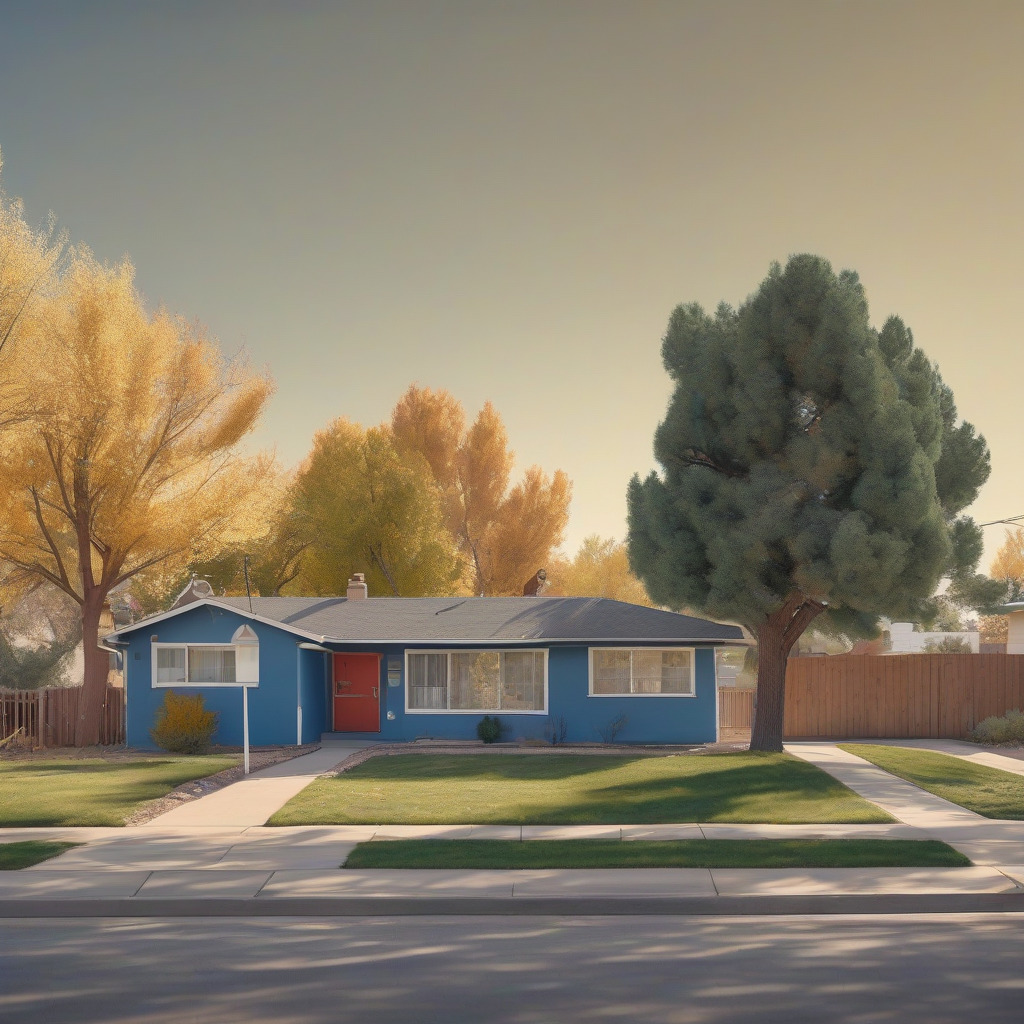
Montbello offers more square footage per dollar than any other neighborhood inside Denver city limits at this price point. These are solid mid-century ranches on lots large enough for a driveway, a backyard, and room for a second vehicle. The neighborhood has a large Latino and Black homeownership community and a substantial park system.
What it doesn’t have is light rail. That matters more than most buyers expect, and the commute section will be direct about it.
Westwood
Median sale price (Aug–Sep 2026): ~$380,000. Typical home: 2–3 bed / 1 bath, 950–1,100 sq ft, 1940s–1950s bungalow. Price per sq ft: ~$290–$320. Average days on market: 15–25.
Westwood has absorbed price pressure from Sloan’s Lake and West Colfax appreciation spreading southwest. You’re paying a location premium over Montbello. The homes are smaller, older, on smaller lots. But the neighborhood has already proven it can appreciate — which is the thing buyers are actually buying when they choose Westwood over somewhere cheaper.
Morrison Road is an underrated commercial corridor. Tacos Acapulco and La Chiva anchor a stretch that feels like a neighborhood rather than a strip. That’s not a small thing when you’re thinking about where you want to live for seven years.
Worth stating plainly: a $380K Westwood purchase delivers roughly 300–350 fewer square feet than the same money in Montbello. That’s not a rounding error. That’s a bedroom.
Villa Park
Median sale price (Aug–Sep 2026): ~$390,000–$415,000 (sample highly variable). Typical home: 2–3 bed / 1 bath, 900–1,050 sq ft, 1940s–1950s bungalow. Price per sq ft: ~$330–$380. Average days on market: 10–20.
Villa Park sits immediately east of Sloan’s Lake. Buyers priced out in 2023–2024 rotated here, and medians have been flirting with — and occasionally crossing — $400K for move-in-ready homes. If you’re working with a $400K ceiling, focus on properties needing cosmetic work or on the western edge.
Ten days on market isn’t much time to deliberate. Budget your financing, get your DPA pre-approval in hand, and be ready.
Globeville
Median sale price (Aug–Sep 2026): ~$340,000–$375,000. Typical home: 2–3 bed / 1 bath, 950–1,100 sq ft, early 1900s–1920s, mix of frame and brick.
Globeville has the lowest price point in this guide. The housing stock is genuinely old — century-plus construction in some cases. Budget for mechanical and infrastructure updates; the low purchase price is not the full cost of entry. Transaction volume is thin, typically fewer than 15–20 sales per quarter, which means the median can move significantly on a handful of closings. Days on market figures for this period are unverified.
The case for Globeville rests on appreciation trajectory, which the investment section addresses directly.
Elyria-Swansea
Median sale price (Aug–Sep 2026): ~$350,000–$385,000. Typical home: 2–3 bed / 1 bath, 900–1,050 sq ft, 1920s–1950s, dense block pattern.
Elyria-Swansea sits immediately south of Globeville and shares most of its characteristics — old housing stock, thin transaction volume, and a trajectory tied to public investment that is underway but not fully delivered. Brighton Boulevard has a more established commercial presence than Globeville, and that matters on a daily basis. Transaction volume is sparse enough that days on market should be treated as unverified for this period.
Sun Valley
Median sale price (Aug–Sep 2026): Sample size is too thin for a reliable median. The mix of DHA resale units (which carry deed restrictions) and market-rate new construction makes direct comparison with other neighborhoods unreliable.
Typical home: 2 bed / 2 bath, 900–1,100 sq ft new construction or rehabbed mid-century. Days on market varies widely by unit type; DHA resale restrictions affect comparability.
Sun Valley is being rebuilt from the ground up, not incrementally improving. The Denver Housing Authority’s redevelopment has introduced new construction townhomes and condos at prices that look high per square foot but include modern systems, warranties, and in some cases deed restrictions. Understand the restriction situation on individual units before you write an offer — you may be buying a 2023-built unit or a 1960s-era home, and the difference matters for financing, insurance, and any five-year hold calculation.
The Commute Tradeoff
Transit quality determines whether a $375K house feels affordable or quietly becomes an economic burden when you factor in car ownership, parking, and time. Here’s what the commute to Union Station actually looks like from each neighborhood.
Sun Valley has the best transit connection in this guide. The W Line runs directly through it; the Decatur-Federal station puts Union Station roughly 8 minutes away by rail. For buyers who prioritize transit, the math is unusually clean: the neighborhood with the most limited private-market inventory also has the best rail access. Make of that what you will.
Villa Park has the Perry station on the same W Line corridor — Union Station runs approximately 20–28 minutes. Walk Score is lower because the street grid connects less directly to commercial density, but the transit basics work.
Westwood lacks light rail. Routes 52 and 65 provide bus service and connections to rail. Door-to-door to Union Station: 35–50 minutes depending on location and connection timing. If you’ve ever sat at the Colorado/Morrison transfer waiting for a bus running eight minutes late, you already understand what “bus service to rail” means in practice. The commute is manageable, but it requires more planning and more tolerance than a W Line ride does.
Montbello is the most transit-constrained neighborhood in this guide for downtown commuters. Routes 28/48 connect to the I-225 light rail corridor; route 61 provides additional connections. Realistic door-to-door to Union Station: 45–60 minutes, depending on connection timing. RTD has not announced light rail expansion to Montbello in any funded capital plan. If you work downtown and don’t own a car, this requires honest self-assessment before you make an offer.
Globeville has no light rail station. The closest rail access is 38th & Blake on the A and B lines, reachable by bus or bike along Brighton Boulevard. The gap is manageable in good weather. In January, cycling that stretch is a different calculation.
Elyria-Swansea faces a similar situation — 38th & Blake is the primary rail access point. Bus routes along Colorado Boulevard and 39th Avenue help, and proximity to the A Line is a genuine asset compared to Montbello. The Central 70 project lowered the highway below grade through this neighborhood, completing construction in 2022. The freeway is less visually present than it was, but it’s still there — the noise corridor remains.
Appreciation — Which Neighborhoods Have Run and Which Are a Longer Bet
Villa Park and Westwood have seen the steepest recent appreciation of any neighborhood in this guide. Buyers priced out of Sloan’s Lake, West Colfax, and Edgewater rotated here. Westwood still carries a price-per-square-foot gap relative to the neighborhoods immediately to its north and east, which suggests some remaining upside — but the sharpest gains have already happened. If you’re buying here expecting mid-to-high single-digit annual appreciation, dial that down.
Montbello appreciated significantly from 2020–2024, driven by buyers who couldn’t afford central Denver. Since 2025, appreciation has slowed and days on market have lengthened from their 2022 peaks. It’s not declining — but it’s moved from rapid appreciation into something steadier. For a first-timer who needs 1,100–1,400 square feet and a yard, Montbello still makes sense on its own terms. Plan on modest returns over five to seven years.
Globeville and Elyria-Swansea have the lowest current prices and the longest investment horizon. Appreciation has been modest, largely because the neighborhoods’ trajectory depends on public investment timelines that have slipped repeatedly. The bet — and it is a bet — is that the National Western Center buildout delivers employment and retail, and that the I-70 cap park moves from planning document to construction. Neither is guaranteed on any buyer-relevant schedule. If you’re buying on a seven-to-ten-year hold, it’s a defensible position. If you need to sell in four years, these are not your neighborhoods.
Sun Valley is a different case. DHA’s redevelopment creates a new neighborhood rather than appreciating an existing one. Resale comps are thin and affected by deed restrictions on some units. Whether market-rate buyers see price gains on a five-year hold is genuinely uncertain in a way that Westwood or Montbello is not — the neighborhood formation is still happening. Sun Valley in 2026 is materially more livable than Sun Valley in 2020. Whether that translates to equity for buyers closing this fall is harder to call.
The Infrastructure Bets — What’s Real and What’s Still a Rendering
Buyers in Globeville and Elyria-Swansea need to be clear-eyed about what they’re actually investing in.
The National Western Center is under construction in phases. The $765M+ public investment — involving Colorado State University, the Denver Museum of Nature & Science, and the National Western Stock Show — has renovated existing facilities and is hosting events. Key facilities remain in mid-phase buildout, with completion targets running through 2027–2030. The employment impact will be legitimate when it arrives. Buy these neighborhoods on what exists today. Proximity to the National Western Center does not yet translate into walkable daily amenities. The construction cranes and utility work will continue for years.
The I-70 cap park over Elyria-Swansea would replace the open highway corridor with a park and reconnect the neighborhood to the street grid on the other side — and it would matter if it gets built. It has gone through multiple planning iterations. The Central 70 project lowered the highway below grade, completing in 2022, and some surface improvements along the corridor are underway. But funding for the cap park itself is not secured. Treat this as a 2030+ scenario, not 2028. Buyers pricing Elyria-Swansea appreciation partly on the cap park should know what they’re betting on.
Sun Valley’s DHA redevelopment is the most actively delivered public investment in this guide. The new street grid is in. First phases of housing are occupied. The Decatur-Federal light rail connection works. Contractors are still active, but the bones of the neighborhood are there. This one isn’t a bet on a rendering.
Westwood’s green infrastructure — Morrison Road improvements, drainage projects, streetscape grants — is mostly delivered. It’s improved quality of life and the neighborhood’s physical appearance without dramatically shifting land use. Incremental, but visible.
RTD expansion is not coming to Montbello or Globeville in any planning horizon a buyer should rely on. RTD has been explicit about its financial constraints and has committed no funding to either neighborhood in any official capital plan. Make your transportation peace with bus service and the existing A Line connection. Don’t buy on the assumption that rail is coming.
Schools — What DPS Open Enrollment Actually Means
Buying a house in Denver does not give your child guaranteed enrollment at a particular school. Not even the one closest to your front door.
Denver Public Schools runs a choice and lottery system. Every family applies during the January–February window. Enrollment is determined by lottery, with siblings, proximity, and certain priority factors weighted in — but those factors are not determinative. Buyers closing in fall 2026 are applying for the 2027–28 school year. Your child may spend the first year of homeownership at a school that wasn’t your first choice.
In Montbello, the boundary school is Montbello High School. DSST: Montbello — a charter with strong outcomes — is located in the neighborhood and available through choice application. John Swigert Aerospace Academy (K–8) is an additional option. Apply specifically. Don’t assume proximity determines placement.
Westwood’s signature option is Kunsmiller Creative Arts Academy (K–12), which has a strong local reputation. Enrollment is by choice application; proximity helps but doesn’t guarantee a seat.
Villa Park students access Eagleton Elementary (K–5) for younger grades. For middle and high school, the choice system takes over.
Globeville and Elyria-Swansea students have Bruce Randolph School as the boundary option — a school that has improved significantly over the past several years. John Swigert Aerospace Academy also serves the area. Apply intentionally. Waiting for default placement is a missed opportunity.
Sun Valley’s enrollment patterns are still stabilizing as the DHA redevelopment builds out the population. Work directly with DPS’s enrollment office rather than assuming anything.
In every neighborhood in this guide, families who apply actively during the January–February window have more options than families who don’t. Don’t buy a house expecting a particular school. Apply for the school you want and verify your status before assuming it.
Making the Down Payment Math Work
On a $375,000 FHA purchase, the 3.5% down payment is $13,125. Total cash at closing includes that plus closing costs, which typically run $8,000–$12,000 depending on loan type, property condition, and lender. For a detailed breakdown of what those fees actually include, our coverage of closing costs for Colorado home buyers walks through the full line-item picture.
CHFA’s Down Payment Assistance offers a second loan at 3–4% of the loan amount. On a $375K purchase with a $361,875 loan (after 3.5% down), a 4% DPA grant covers approximately $14,475 — nearly the entire down payment. The income limit for CHFA programs in the Denver metro runs around $130,000 for a one-to-two person household, which means most working first-time buyers qualify. The second mortgage is forgiven after three years of primary residence. If you stay, you’ve effectively borrowed your down payment for free. It’s a good program.
METRO DPA targets buyers at or below 80% Area Median Income — roughly $80,000 for a single buyer in the Denver metro as of 2026. It covers down payment and can cover closing costs, with no repayment required after three years. For buyers purchasing at $350K–$400K at 80% AMI or below, METRO DPA is often the most efficient tool available.
Denver OED’s HomeOwnership Program provides a forgivable second mortgage for buyers in designated priority geographies. Several neighborhoods in this guide — Globeville, Elyria-Swansea, and parts of Westwood — have historically been included in priority zones. Verify current terms directly with OED; geographic priorities shift annually and what was true in 2024 may not be current.
Now, the part the DPA materials don’t advertise: seller reluctance.
In competitive sub-markets — Villa Park and Westwood especially, where homes move in ten to fifteen days — sellers with multiple offers frequently choose a conventional buyer with 10–20% down over an FHA buyer using DPA assistance. FHA appraisals have condition requirements that can complicate transactions on older homes. DPA adds closing timeline complexity. Lenders sometimes move slower on DPA transactions because underwriting requirements are more stringent. None of this disqualifies DPA. It does mean buyers using FHA plus assistance in these markets should offer closer to ask, write a strong escalation clause, and work with an agent who has recent experience negotiating FHA offers in lower-price submarkets. The programs work. So does the headwind. Plan for both.
The Honest Decision Matrix
These are different options with different tradeoffs. The right answer depends on hold period, household size, and commute tolerance — not on which neighborhood generates the best headline.
You prioritize commute and can accept under 1,100 square feet? Sun Valley and Villa Park first. Both have direct W Line access. Your 45-minute commute becomes a 20-minute train ride, which changes the texture of your daily life more than square footage does. Villa Park’s sub-$400K inventory is increasingly tight, so move with urgency.
You need the most space for the money and want an established neighborhood with a real commercial corridor? Montbello. You’re trading commute convenience for square footage and lot size. A $375K Montbello house gives you room to raise a family; the same money in Villa Park gives you something meaningfully smaller. If schools are a priority, apply strategically — proximity doesn’t determine enrollment. Plan on steady rather than dramatic appreciation over the next five to seven years.
You want appreciation potential on a five-to-seven-year hold and don’t mind a smaller home? Westwood is the strongest candidate, with Villa Park a close second if you can find sub-$400K inventory. Both neighborhoods have already proven they appreciate. Westwood still has some runway relative to Sloan’s Lake pricing. The catch: seller competition is fiercer. Write a clean offer and mean it.
You’re comfortable with a seven-to-ten-year horizon, want the lowest entry price, and believe in the public investment pipeline? Globeville or Elyria-Swansea. These neighborhoods get reflexively dismissed, and that dismissal isn’t entirely earned. The National Western Center is under construction, not on a whiteboard. The cap park may eventually get funded. But buy on what exists today and treat the infrastructure upside as a bonus. If you need to sell in four years, the old housing stock and thin transaction volume work against you. Go in knowing that.
You want new construction at entry-level prices inside Denver? Sun Valley’s DHA redevelopment is the only meaningful source inside city limits at this price point. Understand the deed restriction situation before you make an offer. New construction means newer systems and warranties, which matters when you’re a first-time buyer without a repair reserve. Buyers weighing new construction elsewhere in the metro will find useful context in our coverage of affordable neighborhoods for first-time buyers and in our moving & real estate coverage more broadly.
The post-summer inventory bump in these six neighborhoods is real, and competition is meaningfully lighter than in central Denver. The buyers who navigate this well are the ones who’ve done the price-per-square-foot math, made their peace with the commute, pre-qualified for assistance programs before they’re under contract, and matched their neighborhood choice to their actual household rather than to a list written eighteen months ago.
Data sources: REColorado August–September 2026 transaction data; DMAR Monthly Market Statistical Reports (Q3 2026); RTD trip planner timed routes; DPS 2026–27 school enrollment data; CHFA and Denver OED program documentation current as of September 2026. Sample sizes for Globeville and Sun Valley are thin; treat those medians as directional rather than precise. Price-per-square-foot figures for Globeville, Elyria-Swansea, and Sun Valley were not available from verified sources at press time and are omitted.