How Wildfire Smoke and Air Quality Are Changing Where People Want to Live Around Denver
From Commerce City to Castle Rock, elevation and terrain shape your exposure — and out-of-state buyers are finally asking the right questions

From Commerce City to Castle Rock, elevation and terrain shape your exposure — and out-of-state buyers are finally asking the right questions
The question used to come up maybe once a month. Now, according to relocation agents working Denver’s busiest inbound markets, it comes up in the first consultation. “Where should we look if we’re worried about air quality?” is no longer a niche concern raised by asthma patients and anxious parents. It’s a standard screening criterion, sitting alongside school district ratings and commute times in the mental checklist that buyers — especially those arriving from California, Oregon, and Washington — carry into their home search.
Denver spent the better part of a decade absorbing climate refugees. The pitch was implicit but powerful: leave the burning West Coast, come to the Front Range, where summers are sunny and dry without being catastrophic. That pitch has aged unevenly. Since 2020, Denver has recorded some of the worst air quality days in its modern history, driven by regional wildfires that no longer feel distant. The Cameron Peak fire became Colorado’s largest on record at over 208,000 acres. The East Troublesome fire exploded across Grand County in October 2020. Both sent smoke across the Front Range for days. The mountains, which had always seemed like a natural firebreak, were the source. That particular reversal still gets me.
What follows is a practical geography lesson for anyone deciding where to buy in the Denver metro: how the air actually moves here, which neighborhoods bear the worst of it, what the data shows, and what you can do about it inside your home.
How Denver’s Air Stacks Up Against Other Western Cities
Out-of-state buyers arriving from the Pacific Northwest want a direct comparison. Fair enough — so here’s an honest one.
Portland experienced a catastrophic fire season in September 2020. The AQI climbed past 500, the scale’s upper limit. Salt Lake City, in its bowl of mountains, routinely suffers worse winter inversion pollution than Denver and has seen significant smoke loads in recent summers. Boise has trended worse as Idaho and Oregon fires have intensified. Phoenix’s air quality problems come from dust and ozone rather than smoke, paired with heat so extreme that wildfire season is almost beside the point.
The honest assessment: Denver is not Portland 2020. But it’s no longer the clean-air outlier it was marketed as five years ago. In a bad fire season — 2020, 2021, parts of 2023 — Denver is a city where you will spend meaningful days indoors with the windows sealed if you take the air seriously. That’s a real lifestyle constraint, and buyers are right to factor it in. I’d push back on anyone who tells you otherwise.
Denver’s actual advantage is topographic. Unlike Salt Lake City, trapped in a geographic bowl that holds pollution with brutal efficiency, the Denver metro has enough terrain variation that where you live within it genuinely matters. That’s the thing most buyers don’t think to ask about — and it’s exactly what we track in our moving & real estate coverage.
The Inversion Trap and Why Lower Elevation Doesn’t Mean Safer
This is the piece of terrain mechanics that most buyers get backwards.
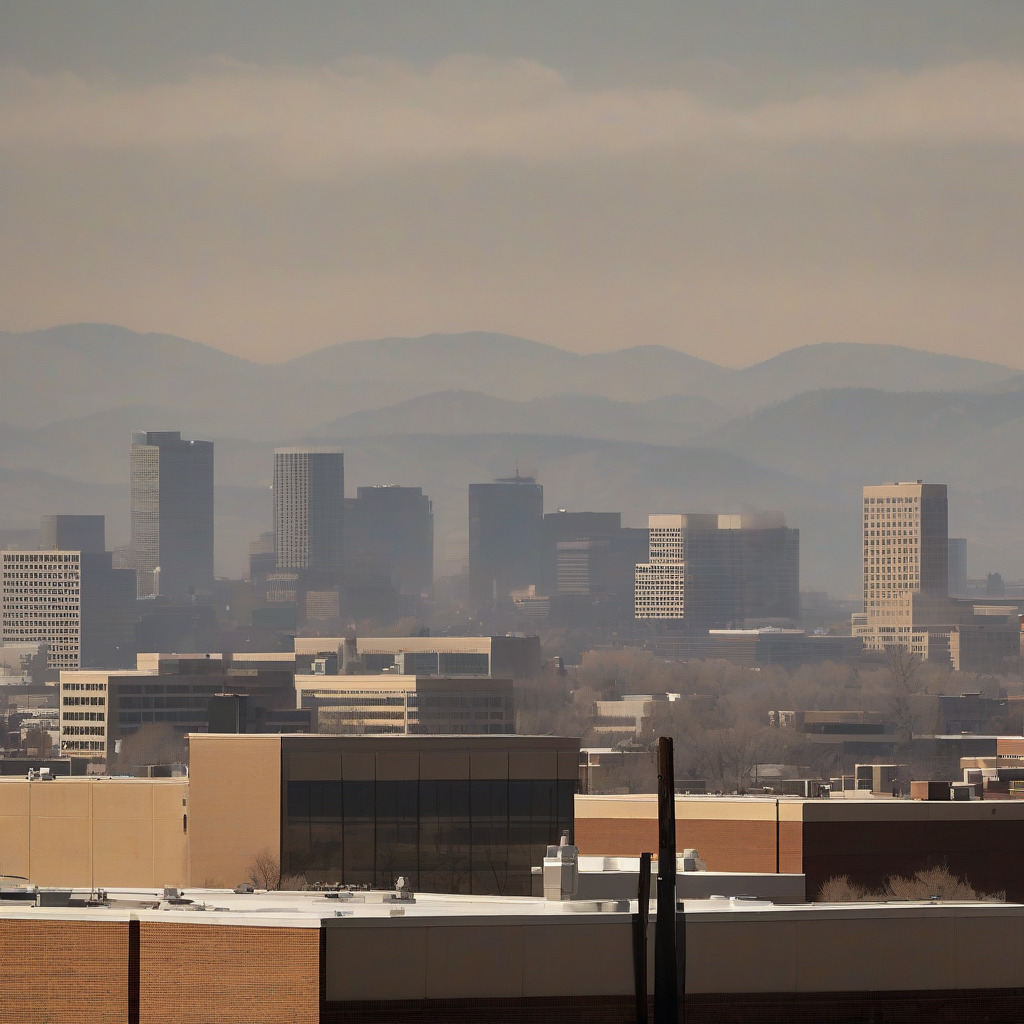
When wildfire smoke rolls into the Front Range — typically on westerly or southwesterly winds during summer — it doesn’t settle uniformly across the metro. Temperature inversions occur when a layer of warm air above cooler surface air acts as a lid, trapping particulate in the lowest-lying parts of the metro. The South Platte River valley, which cuts through the northern and western portions of the metro at its lowest elevations, collects pooled smoke during these events.
The Colorado Department of Public Health and Environment runs an air quality monitoring network across the metro, and the station-level data tells the story plainly. Monitors in Commerce City, Globeville, and the river-bottom industrial corridor north of downtown consistently register higher PM2.5 — the fine particulate measure most associated with wildfire smoke — than monitors in elevated southeastern suburbs during regional smoke events. This disparity shows up clearly in CDPHE’s environmental justice data. A bad smoke week in July might see PM2.5 readings of 180-plus at the Commerce City monitor while the Castle Rock station, 30 miles south at higher elevation, registers 95 on the same day. Same metro, same week, very different air.
The foothills are a more complicated case. Evergreen, at around 7,000 feet, and Conifer are much closer to fire ignition zones in the mountains — a fast-moving fire in Jefferson or Clear Creek County is a real and proximate risk. But when smoke pools at lower elevations during a regional event, foothills residents sometimes find themselves above the worst of the inversion layer. This is not a blanket endorsement of foothills living; the wildfire proximity risk is real and distinct from the smoke exposure risk. The point is that terrain is rarely simple, and the relationship between elevation and air quality runs in different directions depending on what’s generating the problem.
Neighborhood by Neighborhood: Which Parts of the Metro Fare Better and Worse
Commerce City and Globeville carry the heaviest combined air quality burden in the metro. This isn’t only about wildfire smoke. The Suncor Energy refinery north of the I-270 corridor contributes to chronic baseline pollution that compounds smoke events. CDPHE data for the Globeville monitoring station has shown PM2.5 readings during smoke events that outpace most other metro locations. Home prices in Commerce City are lower than in many comparable suburbs. That discount reflects exactly what the monitoring shows, and buyers should understand what they’re actually pricing when they see those numbers.
The equity dimension here is hard to look away from. The neighborhoods with the worst combined pollution burden are also the metro’s lower-income communities — a pattern that mirrors national environmental justice findings. The discount reflects a real environmental cost that falls disproportionately on residents with fewer options.
Castle Rock, at around 6,200 feet in Douglas County on a ridge above the South Platte drainage, consistently performs better in CDPHE comparisons during smoke events. The elevation and topographic position provide real buffering against inversion-pooled particulate. Douglas County’s growth has also brought newer construction with better-sealed building envelopes, which matters for smoke infiltration. It’s the most common destination recommended by relocation agents steering air-quality-conscious buyers toward the southeastern suburbs, and the monitoring data supports the recommendation.
Highlands Ranch, just north of Castle Rock at around 5,700 feet, shares some of the same elevation advantage and benefits from being largely post-1980s construction — tighter homes, more modern HVAC. Parker is similar terrain with a slightly more diverse housing stock that includes older homes requiring more attention to sealing and filtration.
The Broomfield and Erie corridor along US-36 northwest of Denver deserves scrutiny. The Boulder Valley airshed can trap smoke when winds come off the mountains differently than in the southern metro. Erie also sits on the Boulder–Weld County line, an area with oil and gas development that contributes baseline VOC levels. Don’t assume it shares the air quality profile of Douglas County suburbs — pull the monitoring data before you buy.
RiNo and the river-bottom neighborhoods of central Denver occupy the same low-elevation, inversion-prone geography as Commerce City, without the industrial overlay. Buyers paying premium prices in Globeville-adjacent or Sun Valley areas should look at what the CDPHE monitoring data shows about PM2.5 in that corridor. A beautifully renovated bungalow on a river-bottom street is still on a river bottom.
What Out-of-State Buyers Are Actually Asking Their Agents
Relocation specialists working Denver’s California and Pacific Northwest inbound market report a measurable shift in buyer consultations since 2020. The conversation used to lead with crime rates, school rankings, price per square foot. Air quality now enters the first substantive call.
What agents are steering air-quality-conscious buyers toward: the elevated southeastern suburbs — Castle Rock, Highlands Ranch, Parker — for terrain-based buffering, and newer construction anywhere in the metro for the incidental sealing advantage. What they’re flagging for additional due diligence: river-bottom locations, the northern industrial corridor, older homes with drafty windows and original-era construction.
Listing language is beginning to shift. A handful of sellers in newer Douglas County communities have started disclosing HVAC specifications and air filtration ratings in listing descriptions, the way flood zone status or HOA fees get disclosed. This remains the exception. But agents active in the Castle Rock and Lone Tree markets have noted the trend in premium listings — whole-house air filtration appearing as a selling point alongside granite countertops and finished basements. Three years ago, that would have seemed bizarre. Honestly, it still feels a little strange — but it probably shouldn’t.
National Jewish Health and the Clinical Perspective
National Jewish Health, on Jackson Street in Denver, is a respiratory hospital whose physicians are now fielding questions not just from existing patients with asthma or COPD, but from prospective residents deciding whether Denver is a viable place to relocate. That’s a telling shift, and it translates into real estate terms in specific ways.
The EPA classifies AQI above 100 as Unhealthy for Sensitive Groups — the threshold at which people with asthma, COPD, heart disease, or other cardiopulmonary conditions should limit outdoor exposure. Above 150 reaches the Unhealthy classification that warrants concern for everyone. For patients with significant respiratory conditions, home selection becomes a medical consideration. Neighborhood elevation, HVAC filtration capacity, window sealing — these are medical factors, not lifestyle preferences. They’re material to whether the home is clinically suitable.
Consider the practical math. A patient with moderate COPD in a Commerce City home without meaningful filtration might spend 30 or 40 days per year in an unhealthy AQI range. The same patient in a sealed newer home with MERV-13 filtration at higher elevation might see 10. That’s not a rounding error. That’s a third of the summer.
Inside the Home: What Denver Residents Are Actually Doing
The geography question and the home question are related but distinct. Even in a well-situated suburb, heavy smoke seasons require active management. The 2020 and 2021 seasons were, for a lot of people, the moment that clicked.
MERV-13 furnace filter upgrades are the first and most cost-effective intervention. These filters capture the particulate range most associated with wildfire smoke. Local HVAC contractors — Applewood Plumbing, Heating and Electric is one of the metro’s larger residential firms — can assess whether your existing system is compatible with a higher-rated filter, since they can restrict airflow in older systems. The filter itself runs around $40 and takes 20 minutes to install. In a home with people who have respiratory conditions, it’s one of the highest-return interventions available.
Whole-house ERV and HRV systems — energy recovery ventilators and heat recovery ventilators — are appearing with more frequency in newer Castle Rock and Highlands Ranch construction. These systems allow controlled fresh air exchange while filtering incoming air, which matters in a climate where you want windows shut for smoke in summer and sealed tight against cold for six months in winter. In a new-construction purchase, ask specifically whether the home includes one, and what its filtration rating is. A quality system runs $3,000 to $6,000 installed but provides year-round air management that goes well beyond emergency smoke response.
The Corsi-Rosenthal box circulated widely in Denver neighborhoods after the 2020 fire seasons. It’s a DIY air purifier built from a box fan and four MERV-13 furnace filters — simple, costs around $40 in materials from any hardware store, and provides real supplemental filtration in a bedroom or home office. If you’ve never built one, it takes about 20 minutes and feels slightly absurd until you check the air quality readings. It’s a practical option for renters without control over HVAC systems, or for anyone who wants a high-filtration zone in one room during a smoke event.
Colorado’s cold-climate construction standards have pushed builders toward tighter envelopes for energy efficiency. This provides real smoke protection compared to older construction — sealed homes stay cleaner longer during smoke events. A 1970s brick bungalow in Washington Park, even at similar elevation to a 2010 ranch in Highlands Ranch, will see smoke infiltrate faster during a heavy pollution event. The character is real; so is the tradeoff.
Wood-burning is worth flagging for buyers eyeing older Capitol Hill, Washington Park, or Berkeley homes with working fireplaces. Denver’s Air Pollution Control Division issues Wood-Burning Curtailment Days when air quality deteriorates, and on those days burning is prohibited outright for most residential fireplaces. The restriction typically falls from June through September in heavy fire years — which is exactly when you’d most want the amenity. Worth knowing before you fall in love with the fireplace during a January showing.
What to Ask Before You Buy
For anyone actively in a home search, here are concrete due-diligence steps. None take more than an afternoon.
Pull the AQI history for the address. AirNow offers historical air quality data by location. Run the address or nearest ZIP code through the historical data tool and look at June through September readings across the last three or four years. Count the days above 100 and above 150. When you see the data, you’ll understand quickly whether a neighborhood is a moderate-smoke area or a heavy one.
Find the nearest CDPHE monitoring station. The CDPHE Air Quality Data Portal lists active stations across the metro with downloadable PM2.5 data. Identify which station is closest to the property and compare its recent summer data against other metro stations. The difference between a river-bottom station and a Douglas County station in a bad smoke week can run 50 to 100 AQI points.
Ask the seller’s agent about the HVAC filtration spec. What filter rating does the system run? Is it compatible with MERV-13? Has it been serviced recently? These questions aren’t unusual — treat them like asking about the age of the water heater.
Check window and door sealing. When was weatherstripping last replaced? Are windows double- or triple-pane? In an older home, a visual inspection of window sealing often tells you what you need to know. Single-pane windows are a red flag if air quality is a priority.
Ask whether the home has a whole-house air purification system or ERV/HRV. In newer construction, this should be in listing disclosures or the builder’s spec sheet. In resale homes, sellers who have invested in upgraded filtration are increasingly willing to disclose it. Get the model number and filtration rating before you make an offer.
Check the elevation and immediate terrain. Is the property in a valley bottom, on a ridge, or on open plain? Valley-bottom properties at lower elevations warrant extra scrutiny of the home’s ability to function as a sealed environment. Google Earth or the USGS topographic map viewer takes five minutes.
Talk to a local HVAC contractor before closing. A pre-purchase inspection that evaluates filtration capacity and overall air-sealing quality runs $150 to $300 and gives you a concrete assessment of what upgrades are realistic. If air quality is a priority, it’s money well spent.
Whether wildfire smoke is a real factor in choosing where to live near Denver is no longer a debatable question. It is.
The more useful answer is that exposure is not uniform across the metro. Elevation and terrain create genuine differences in how hard smoke events hit specific neighborhoods, and the home’s construction matters as much as the ZIP code. Buyers who treat air quality as a binary pass/fail — Denver or not Denver — are asking the wrong thing.
The right questions are specific: What’s the elevation? What vintage is the construction? What’s in the mechanical room? A buyer in a newer home with MERV-13 filtration on a Douglas County ridge has fundamentally different smoke exposure than a buyer in a 1950s riverside bungalow in RiNo, even though they’re both in the Denver metro.
Denver’s relocation agents know this now. Denver’s respiratory physicians have known it longer. The buyers who do their homework before they sign won’t be surprised when August smoke rolls in off the Rockies and the AQI climbs past 150. They’ll know exactly what trade-offs they made — and whether those trade-offs were worth it.