How to Get Your Car Through Colorado Emissions Testing in Denver
Denver drivers rarely think about air quality until their vehicle registration renewal arrives in the mail and they realize they can't get new tabs without an emissions test certificate first. For …

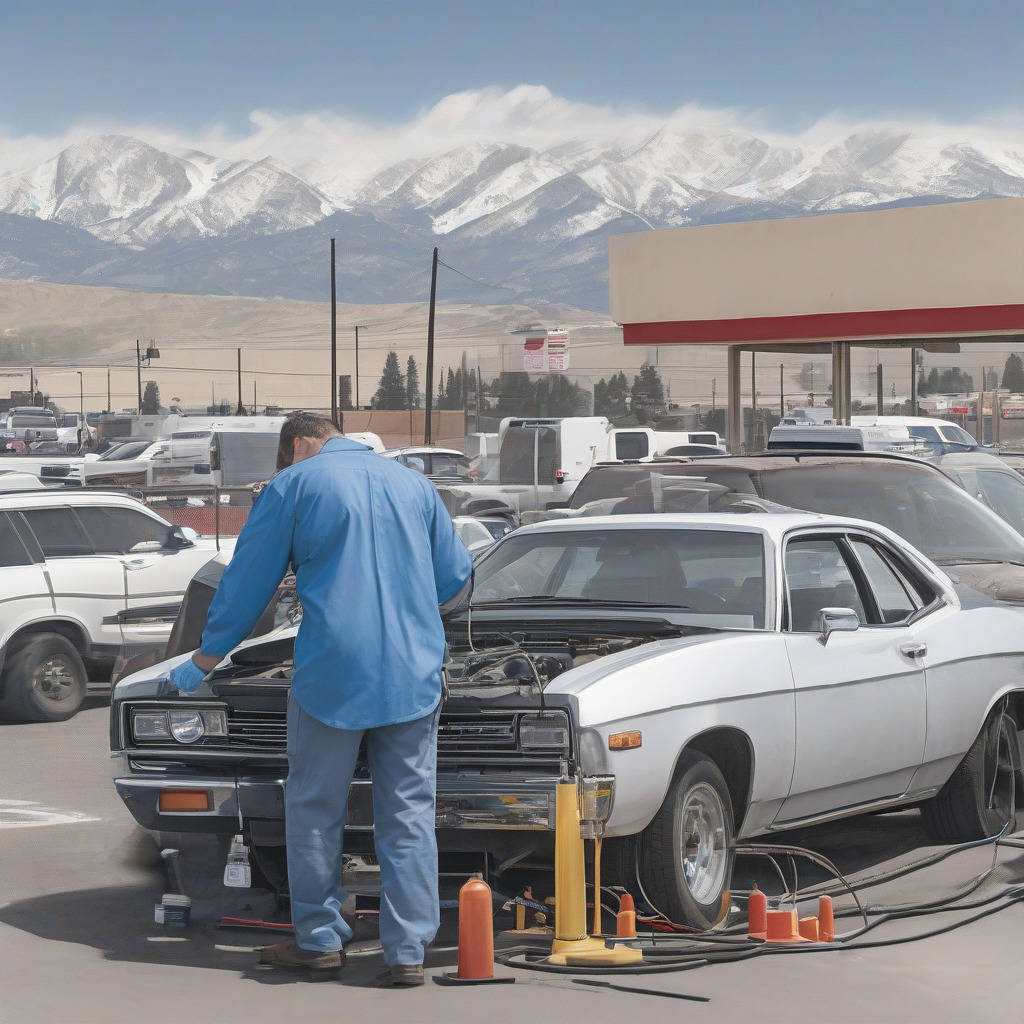
Denver drivers rarely think about air quality until their vehicle registration renewal arrives in the mail and they realize they can’t get new tabs without an emissions test certificate first. For metro-area residents, that notice is the moment the state’s vehicle inspection program stops being an abstraction and becomes a Tuesday afternoon problem. This guide answers the practical questions in plain terms: whether your car needs testing, where to go, what the test costs, and what happens if your vehicle doesn’t pass.
Why Denver Has an Emissions Testing Requirement
The short answer is federal law. The longer answer is the brown cloud.
The Denver metro sits within a federally designated “serious” non-attainment zone for ground-level ozone. That classification, under the Clean Air Act, imposes specific obligations on the state, including running a vehicle inspection and maintenance program. Ground-level ozone isn’t the ozone layer — it’s formed when vehicle exhaust and industrial emissions cook in sunlight, and it’s a genuine respiratory hazard, particularly during summer months when Front Range meteorology traps pollutants against the mountains. If you’ve ever noticed that hazy brownish band sitting at the base of the Rockies on a hot August afternoon, that’s the problem the program is trying to address.
Colorado’s response is the Air Care Colorado program, administered by the Colorado Department of Public Health and Environment (CDPHE) through its Air Pollution Control Division. The registration tie-in gives the program teeth: if your vehicle is subject to testing and you don’t have a passing certificate, the Colorado DMV won’t issue a renewed registration. That’s not an environmental talking point. It’s the practical reality that brings a large share of metro-area vehicles through the system every year.
Does Your Vehicle Actually Need Testing
Before you look up the nearest station, confirm that your vehicle is actually subject to the requirement. A surprising number of drivers make unnecessary trips because they assumed their car needed testing when it didn’t — or skipped the trip because they assumed an exemption applied when it didn’t. Both mistakes cost you time.
Your vehicle needs an emissions test if all of the following apply: it’s registered in one of the seven-county metro area (Adams, Arapahoe, Boulder, Broomfield, Denver, Douglas, or Jefferson County); it’s a gasoline-powered car, light truck, or SUV with a gross vehicle weight rating under 8,501 pounds; it’s model year 1982 or newer; and it’s more than seven model years old. That last requirement means new vehicles get a seven-year grace period before their first test.
You don’t need testing if your vehicle is fully battery-electric. BEVs are exempt — no qualification period, no waiting, no asterisks. Motorcycles, mopeds, vehicles with antique or collector plates, and vehicles registered outside the seven-county area are all exempt. Diesel testing requirements vary substantially by vehicle weight, model year, and configuration. If you own a diesel, confirm your specific situation with CDPHE before assuming either way.
The plug-in hybrid question trips up a lot of drivers, and online coverage often gets it wrong. Plug-in hybrid electric vehicles (PHEVs) are subject to emissions testing in Colorado because they have a gasoline combustion engine. The battery range doesn’t exempt the vehicle. If you drive a PHEV registered in the seven-county area and it’s more than seven years old, you need to test. Battery-only vehicles are fully exempt because there’s no combustion engine at all. It’s that simple, and yet I see the confusion come up constantly.
For situations that don’t fit cleanly into these categories, the CDPHE’s Air Pollution Control Division can clarify by phone before you make the trip.
There Are No Government Testing Lanes — Here’s What That Means
This is the most common misconception Denver drivers bring to this topic. Colorado does not operate state-run emissions testing facilities. There’s no DMV annex where you queue up on a Saturday morning to get a government inspection. Every emissions test in Colorado is performed at a privately owned, AIRS-certified testing station authorized under the Air Pollution Control Division.
AIRS — the Automotive Inspection and Readout System — is the state’s electronic infrastructure connecting certified stations to the CDPHE. When a station runs your vehicle through the inspection process, the result is transmitted directly into the state’s database. The document you receive, a Vehicle Inspection Report (VIR), is the official state record of the outcome. This matters because only AIRS-certified stations can generate a VIR that counts for registration renewal purposes, and only AIRS-certified repair shops can submit the repair documentation required for a cost-of-repair waiver. You can’t take your car to a friend’s shop or a non-certified mechanic and have those repairs count toward the waiver threshold. No exceptions.
To find currently certified stations, use the official Colorado Air Care locator at colorado.gov/aircare. Certification status changes. Stations can lose authorization, close, or change hours. Any static list in a news article — including this one — requires verification before you make the drive. The state locator reflects current status in real time.
Where to Get Tested Near Central Denver
Rather than directing you to a county-level database and leaving you to sort it out, here’s how the certified station locations map to the neighborhoods where most CityDesk Denver readers following our automotive coverage live. All of the following should be verified against the state locator before you visit. Hours change, stations close, and new ones open.
North and Northeast Denver (Globeville, Elyria-Swansea, Montbello, Cole)
The I-70/I-25 corridor through north Denver is auto-service-dense, and the testing station concentration reflects it. Montbello, which has one of the metro’s older vehicle populations, has historically had accessible options along Chambers Road and the 56th Avenue commercial strip. Globeville and Elyria-Swansea are closer to the Federal Boulevard stations and the Brighton Boulevard corridor. If you live in Cole or Clayton, East Colfax stations in Aurora are often faster to reach than navigating downtown.
Federal Boulevard Corridor (Barnum, Westwood, Harvey Park, Berkley)
Federal Boulevard from Alameda to 52nd Avenue is one of the densest auto-service corridors in metro Denver, and it includes multiple certified testing stations. For drivers in Barnum, Westwood, Harvey Park, and Berkley, this is typically the most convenient option. Morrison Road intersections along this corridor are particularly well-served.
South Broadway (Rosedale, South Pearl, Platt Park)
The Broadway auto corridor from Evans to Hampden includes certified stations mixed in with the dealerships and service centers that define that stretch. For residents of Rosedale, South Pearl Street, and Platt Park, South Broadway stations are often the shortest drive. This corridor tends to have higher traffic volume overall, so mid-week morning visits pay off more here than they do on the Federal Boulevard corridor.
East Colfax and Aurora (Capitol Hill, Five Points, Whittier, City Park)
Capitol Hill and Five Points residents have a natural corridor to Aurora along Colfax and the East Colfax strip, where there are multiple certified stations. Aurora itself, along Havana Street and the Colfax corridor east of Yosemite, has multiple certified stations that are accessible without a full highway trip. For a Capitol Hill resident, the drive east on Colfax to a certified Aurora station is often faster than fighting toward Federal or Broadway — and in my experience, the waits are shorter too.
West Denver and Lakewood (LoHi, Sunnyside, Sloan’s Lake, West Highlands)
Residents of LoHi, Sunnyside, and Sloan’s Lake are well-positioned for both the Federal Boulevard corridor and the Lakewood/Wheat Ridge stations accessible via West Colfax or 6th Avenue. Lakewood has multiple certified stations along Wadsworth and Kipling, with parking and access that’s typically easier than the urban Denver corridors. For west Denver drivers, this is often the path of least resistance during high-volume periods. Verify current locations at colorado.gov/aircare, confirm hours, and check whether a station handles your vehicle type. Some specialize in lighter passenger vehicles; others handle trucks and heavier GVWRs. Don’t drive to a station based on a cached map result or an old Yelp listing.
What to Expect When You Arrive — Cost, Process, and Time
The test fee in Colorado currently runs approximately $25 to $30 for most light-duty gasoline vehicles. Verify the current fee with the station when you call ahead, as rates can adjust. There are no state coupons or discount programs for the basic test fee.
The inspection itself, once your vehicle is in the bay, takes roughly 15 to 25 minutes. An OBD-II scan covers vehicles model year 1996 and newer — the onboard diagnostics system communicates directly with the station’s equipment. Older vehicles, generally those from 1982 through 1995, undergo a dynamometer test where the car is run on rollers while exhaust emissions are measured at the tailpipe. Both processes are straightforward. You typically wait in your vehicle or a waiting area.
Total visit time depends almost entirely on how busy the station is when you arrive. At off-peak times, you can be in and out in under 30 minutes including the wait. At peak times, you may sit in a queue before your vehicle reaches the bay, with total visit time potentially reaching 90 minutes. That’s a long time to sit in a parking lot, which brings me to the timing question.
Colorado’s registration renewals are tied to the vehicle owner’s birth month, which creates predictable surge patterns. The last week of each month is consistently the highest-traffic period at testing stations, as drivers scramble to meet renewal deadlines. October and November see elevated volume as drivers with winter registration deadlines and those who avoided summer testing all converge. The lowest-friction window is mid-week mornings — Tuesday through Thursday. If you can arrange the trip on a Wednesday morning, you’ll typically spend the minimum possible time in a queue. It’s not a guarantee, but it’s the closest thing to one that this process offers.
Denver’s elevation of 5,280 feet affects combustion chemistry in ways that matter for testing. Air is thinner, which changes the fuel-to-air mixture in the engine, and Colorado’s testing program uses standards calibrated to account for this. The state runs its own program rather than simply deferring to federal minimums. In practical terms, older carbureted vehicles that run acceptably at lower elevations may run rich here. A tune-up calibrated for sea-level conditions isn’t the same as one tuned for Front Range conditions — something worth knowing if you recently moved here from out of state and your car passed easily back home.
If Your Car Fails — What the VIR Means for Your Registration
Failing the emissions test is genuinely inconvenient and potentially expensive. You deserve a straight account of what happens rather than reassurance.
When your vehicle fails, the station issues a Vehicle Inspection Report that documents the failure. This VIR is transmitted to the CDPHE database. The DMV can see the failure on your record, and you won’t be able to renew your registration without either a subsequent passing certificate or an approved waiver. What a failure does not do is trigger an impound, result in a citation, or void your existing registration. If your registration is still current when you fail, you continue to drive legally on that registration until it expires. You have time to arrange repairs and retest before your registration deadline. This is why it matters to test early rather than in the final days before your renewal is due — a lesson that’s much easier to apply in theory than in practice, I realize, but worth stating plainly.
The sequence after failure is straightforward: take the VIR to an AIRS-certified repair facility, have the emissions-related problems diagnosed and repaired, then return to a certified testing station for a retest. Retest fees and free-retest policies vary by station. Some offer a free first retest within a defined window if you return to the same station; others charge the standard fee for every test. Ask when you receive your VIR.
An illuminated CEL at the time of testing complicates this timeline. A check-engine light is an automatic failure for OBD-II vehicles. The station won’t complete the full test. If your CEL is on, address the underlying codes before you pay for a test.
The Waiver — When Repair Costs Outpace the Car’s Value
Colorado’s program recognizes that some vehicles — particularly older, lower-value cars — can generate repair estimates that exceed what the car is reasonably worth. The cost-of-repair waiver is the program’s accommodation for that situation, and it’s worth understanding before you start authorizing expensive work.
The waiver threshold — the amount in documented qualifying repair costs you must reach before you’re eligible — is currently in the range of $715 to $1,000, with the precise figure for 2026 requiring confirmation from CDPHE before your application. Confirm the current figure with the CDPHE Air Pollution Control Division before planning your repair strategy around it.
A waiver allows you to renew your registration for one additional year despite a failing test result, after demonstrating that you made a good-faith effort to repair the emissions problems by spending at least the threshold amount on qualifying repairs. This is not a permanent exemption. When the one-year period ends, your vehicle is subject to testing again. If it fails again and repair costs again exceed the threshold, you can apply again. The program is designed to move vehicles toward compliance over time, not to provide indefinite registration access for non-compliant vehicles.
Repair receipts must be from AIRS-certified repair facilities. Receipts from uncertified shops, however reputable, don’t count toward the threshold. Repairs must target emissions-related components. A new set of tires or a brake job doesn’t move you toward the waiver threshold, even if it was expensive. Receipts must be current. You can’t aggregate years of old repair records.
Catalytic converter replacement is the single most common repair that pushes costs above the waiver threshold. On most late-1990s through early-2000s vehicles, a catalytic converter plus labor runs between $800 and $2,500 in the Denver market depending on the vehicle, the converter specification, and the shop. OEM converters are more expensive than aftermarket units, and some vehicles require multiple converters. Get written estimates from at least two certified shops before authorizing the work. The price variation in Denver is significant — I’m not exaggerating when I say you can get quotes that differ by $600 for the same job on the same vehicle.
Oxygen sensor replacement, EGR valve service, and EVAP system repairs are the next tier of commonly required work. O2 sensors typically run $150 to $400; EGR valve service usually runs $200 to $600. Vehicles that have deferred maintenance often need multiple repairs simultaneously, which is how a marginal failure becomes a repair bill that approaches or exceeds the waiver threshold. If your vehicle is borderline — older, high-mileage, with a modest market value — it’s worth getting a pre-test diagnosis at a certified shop before paying for the test. You’ll understand the repair situation before the clock starts.
Which Shops Can Do Qualifying Repairs — and How to Vet Them
The AIRS certification requirement for repairs isn’t bureaucratic box-checking. It’s the mechanism that connects the repair to the waiver database. Only shops with AIRS certification can submit the electronic documentation that the CDPHE recognizes for waiver purposes. A receipt from a non-certified shop, even a highly competent one, won’t satisfy the requirement.
The state maintains a certified repair shop locator alongside the station finder at colorado.gov/aircare. Use it to filter by your area before committing to a shop. Shop status changes. Don’t rely on a static list.
The Federal Boulevard corridor from Alameda to 52nd Avenue has the highest concentration of certified repair facilities in the city proper. Morrison Road and the Barnum/Westwood corridor have several options as well. South Broadway from Evans to Hampden has certified shops interspersed with dealership service centers, some of which are certified. East Colfax into Aurora is the corridor for east-side and Capitol Hill residents. Montbello has options along the 56th Avenue and Chambers corridor.
Before you commit to a shop, confirm certification through the state locator. Don’t take a shop’s word for it, because certification lapses. Get a written estimate for the specific repairs the VIR identified as failing components before authorizing any work. A reputable shop will provide this without pressure. For catalytic converter replacement specifically — the highest-cost item most Denver drivers will face — get estimates from at least two certified shops. Ask specifically whether the quoted converter is OEM, OEM-equivalent, or aftermarket, and whether it’s California-spec. Some emissions failures recur after aftermarket converter installation on older vehicles if the replacement unit doesn’t match the engine management system’s expectations. A shop that can explain the distinction and justify their recommendation is showing competence. One that can’t is a flag worth paying attention to.
Before You Pull Into the Testing Bay — How to Avoid a Preventable Failure
A few pre-test steps can save you the cost of a test you’re going to fail and the time of rescheduling. These aren’t exotic precautions — they’re the kind of thing that feels obvious in retrospect but that a lot of drivers skip.
If your CEL is illuminated, don’t go to the test. On OBD-II vehicles (1996 and newer), the station’s equipment reads the CEL status as the first step of inspection. An illuminated light is an automatic failure regardless of what the actual emissions numbers show. Have the codes pulled first. Many auto parts stores will read OBD-II codes at no charge. Understand what you’re dealing with before paying for a test.
Even if your CEL is off, a vehicle that had its battery recently disconnected — or that had a code recently cleared — may not have enough drive cycles completed to set all its readiness monitors. If the OBD-II system isn’t ready, the station can’t complete the inspection. A scan at an auto parts store will show you monitor status before you queue up. This is a five-minute errand that has saved more than a few drivers from a wasted trip.
Vehicles that are marginally compliant, particularly older ones with aging emission control components, tend to run richer in cold conditions. If your vehicle is borderline and you have flexibility, schedule testing in warmer months. A vehicle that squeaks through in September might fail in January. Drive at least 15 to 20 minutes, including some highway-speed operation, before pulling into the testing bay. This ensures the catalytic converter is at operating temperature and the engine management system is fully in closed-loop operation. Cold engine tests are less favorable than tests on a fully warmed-up vehicle.
None of this guarantees a pass on a vehicle that has genuine emissions problems. But it eliminates the entirely avoidable failures that cost drivers $25 to $30 and a half-day of their time.
Resources
Colorado Air Care station and shop locator: colorado.gov/aircare — use this for real-time certified station and repair shop locations, hours, and contact information. This is the authoritative source; everything else, including this article, is secondary.
CDPHE Air Pollution Control Division: The APCD handles waiver applications and can answer program questions directly. Contact information is available at cdphe.colorado.gov. For waiver questions specifically — including the current cost threshold for your vehicle type — call before making repair decisions.
Colorado DMV registration renewal: dmv.colorado.gov — confirms what documentation you’ll need to complete renewal once you have a passing certificate or approved waiver.
CDPHE ozone information: cdphe.colorado.gov — background on the Denver metro’s air quality status and ozone season notifications, which run roughly May through October.
Hours, fees, certification status, and program thresholds change. Verify all information with official sources before visiting any location or making repair decisions based on figures in this article.