Winter Tires vs All-Season Tires for Denver Drivers Heading Up I-70
If you moved to Denver from anywhere flat, you've probably heard the same advice from a well-meaning coworker: "You'll be fine up in the mountains, just get an AWD." It's not malicious guidance. It…

If you moved to Denver from anywhere flat, you’ve probably heard the same advice from a well-meaning coworker: “You’ll be fine up in the mountains, just get an AWD.” It’s not malicious guidance. It’s just wrong. You can face up to $650 in fines before you even reach Vail Pass.
This piece covers what a Front Range driver genuinely needs to know before heading west on I-70 between November and April: what Colorado law actually requires, where the tire science gets counterintuitive, what altitude does to your tire pressure between Denver and Eisenhower Tunnel, and what local shops are recommending right now.
The short answer to the question Denver transplants most often ask: standard all-season tires are not good enough for regular mountain driving in Colorado winter, and AWD alone does not substitute for compliant tires under state law. Whether you need dedicated winter tires or whether a 3PMSF-certified all-weather tire gets you there depends on how often you’re making the run and how willing you are to manage a second set. But “I’ve got AWD and decent all-seasons” is not a plan. It’s a gamble, and the house has significant advantages on Vail Pass in February.
Colorado’s Traction Law and the Widespread AWD Misconception
Colorado’s traction law operates in two tiers, and the distinction catches drivers off guard in ways that cost them real money.
Code 15 is the standard winter condition. CDOT requires all vehicles to have tires with a minimum 3/16-inch tread depth and the Three-Peak Mountain Snowflake (3PMSF) certification, or chains or an approved traction device. AWD or 4WD alone does not satisfy this requirement. That’s the central misconception — and it’s remarkably persistent, even among people who’ve been driving up I-70 for years.
Code 16 kicks in during severe conditions: all vehicles must have chains, 3PMSF-certified tires with 3/16-inch tread depth, or an approved traction device. AWD or 4WD vehicles can still satisfy Code 16, but only when equipped with qualifying tires meeting the tread and certification requirements. This is where drivers with premium all-wheel-drive SUVs and factory all-season tires get turned around or cited. Fine exposure runs up to $650 for a passenger vehicle.
The law covers I-70 from the Morrison/C-470 interchange (milepost 259) west to Dotsero (milepost 133) — the entire mountain corridor including Floyd Hill, Georgetown, Eisenhower Tunnel, Vail Pass, and the descent into Glenwood Canyon. CDOT pulls vehicles at enforcement checkpoints, most commonly near Idaho Springs and at the Vail Pass summit. They’re not running a bluff operation.
Here’s where the misunderstanding really embeds itself. “Mud and Snow” (M+S) is a self-certification. Tire manufacturers apply it without independent testing. Many all-season tires carry an M+S rating, but that designation alone does not satisfy Colorado’s traction law under any enforcement code. The 3PMSF snowflake symbol — mountain outline, snowflake inside, on your sidewall — is earned through standardized testing and is the only certification that matters for legal compliance. Check your sidewall now, before you read another word. If you see “M+S” without the snowflake, you’re on a standard all-season tire, and AWD will not save you from a citation.
For real-time traction law status before departure, CDOT’s COtrip.org and the 511 phone line are the authoritative sources. Status can change between when you leave Denver and when you reach Eisenhower Tunnel — sometimes dramatically, sometimes within the hour.
Legal Compliance Side by Side
Here is how the three main tire categories stack up against Colorado’s requirements:
| Criteria | Dedicated Winter Tire (e.g., Blizzak WS90) | 3PMSF All-Weather (e.g., CrossClimate2) | Standard All-Season (M+S only) |
|---|---|---|---|
| Code 15 compliant | Yes | Yes | No — M+S alone does not satisfy Code 15 regardless of tread depth |
| Code 16 compliant | Yes | Yes | No — fails regardless of AWD or tread depth |
| 3PMSF certified | Yes | Yes | No — M+S only |
| Tread depth ≥ 3/16” (new) | Yes | Yes | Yes |
| Year-round usability | No — summer heat degrades compound | Yes | Yes |
A brand-new Audi Quattro wearing standard all-season tires does not satisfy Code 15 or Code 16. A front-wheel-drive car wearing Michelin CrossClimate2s satisfies both. AWD is a traction aid. It does not change what the law requires on your sidewall.
The 45°F Line and When All-Season Tires Become a Genuine Hazard
Temperature is where the all-season tire’s compromise becomes a concrete safety problem rather than a theoretical one. The rubber compounds in standard all-season tires are engineered for a broad range of temperatures, but below approximately 45°F, those compounds begin hardening in ways that measurably reduce grip. They don’t fail catastrophically. They get progressively worse — which is actually more dangerous, because the degradation is difficult to feel from the driver’s seat until you need emergency braking or evasive steering. By the time you notice the problem, you’re already in it.
In Denver’s climate, 45°F is not an extreme cold threshold. It’s a routine mid-November morning. The window during which temperatures in the I-70 corridor regularly drop below that mark runs roughly from mid-November through mid-March, though October has a documented history of early surprises. The October 2019 storm dropped 8 to 14 inches along the Front Range and lower mountain corridor while most drivers were still on all-season rubber, and the Floyd Hill incident logs that weekend were ugly.
Three segments on I-70 produce the most incidents tied to under-equipped tires. As we’ve tracked in our automotive coverage, equipment choices on the Front Range corridor are among the most consequential decisions Denver drivers make each winter season.
Floyd Hill, just west of Morrison, is a sustained uphill grade westbound and a steep descent on the return. It concentrates incidents in early-season snowfall events — before drivers have mentally shifted to mountain-driving mode — and in Chinook conditions, when warm air down the eastern slope creates wet pavement that freezes fast after sunset. High traffic volume, a real grade, and drivers on degraded all-seasons make Floyd Hill consistently one of CDOT’s highest-incident segments per mile. It has a way of making believers out of skeptics. Fast.
Georgetown to Eisenhower Tunnel is where compound failure and tread depth failure interact. The grade steepens significantly west of Silver Plume — 6 to 7 percent westbound at the tunnel’s east portal — and elevation means temperatures typically run 10 to 20°F colder than Denver at the same hour. Drivers who set out in 38°F Denver arrive at the tunnel approach in conditions where all-season rubber is operating well outside its effective range. And at that point on the highway, you’re committed to the climb. There’s no good place to reconsider your equipment choices.
Vail Pass (10,662 feet) is where brake-heat stress on tires intersects with compound hardening and significant grades on the westbound descent. CDOT’s incident logs show consistent clustering here during Code 15 conditions, particularly in hard-braking scenarios from drivers running equipment not suited to the task.
The distinction between tread depth failure and compound failure matters because they require different diagnoses. A tire at or below 3/16-inch tread has failed on depth, full stop. A tire with adequate tread but operating below 45°F has failed on compound performance with no visible indicator. Both leave you without grip when you need it — only one announces itself in advance.
What Happens to Your Tire Pressure Between Denver and Eisenhower Tunnel
Tire pressure drops approximately 1 to 2 PSI for every 10°F temperature decrease. The trip from Denver (5,280 feet, 45°F on a November morning) to Eisenhower Tunnel (11,158 feet, where it might be 15°F) represents roughly a 30°F drop. You can lose 3 to 6 PSI of tire pressure over that stretch without a single nail in the tread. This isn’t a slow leak. It’s physics, and it happens every time.
Most drivers check tire pressure in a warm parking garage before departure, then arrive at the Eisenhower approach underinflated by several PSI without knowing it. Underinflated tires in winter conditions mean less responsive handling and uneven road contact. That’s exactly what you don’t want on a 6 percent grade in blowing snow.
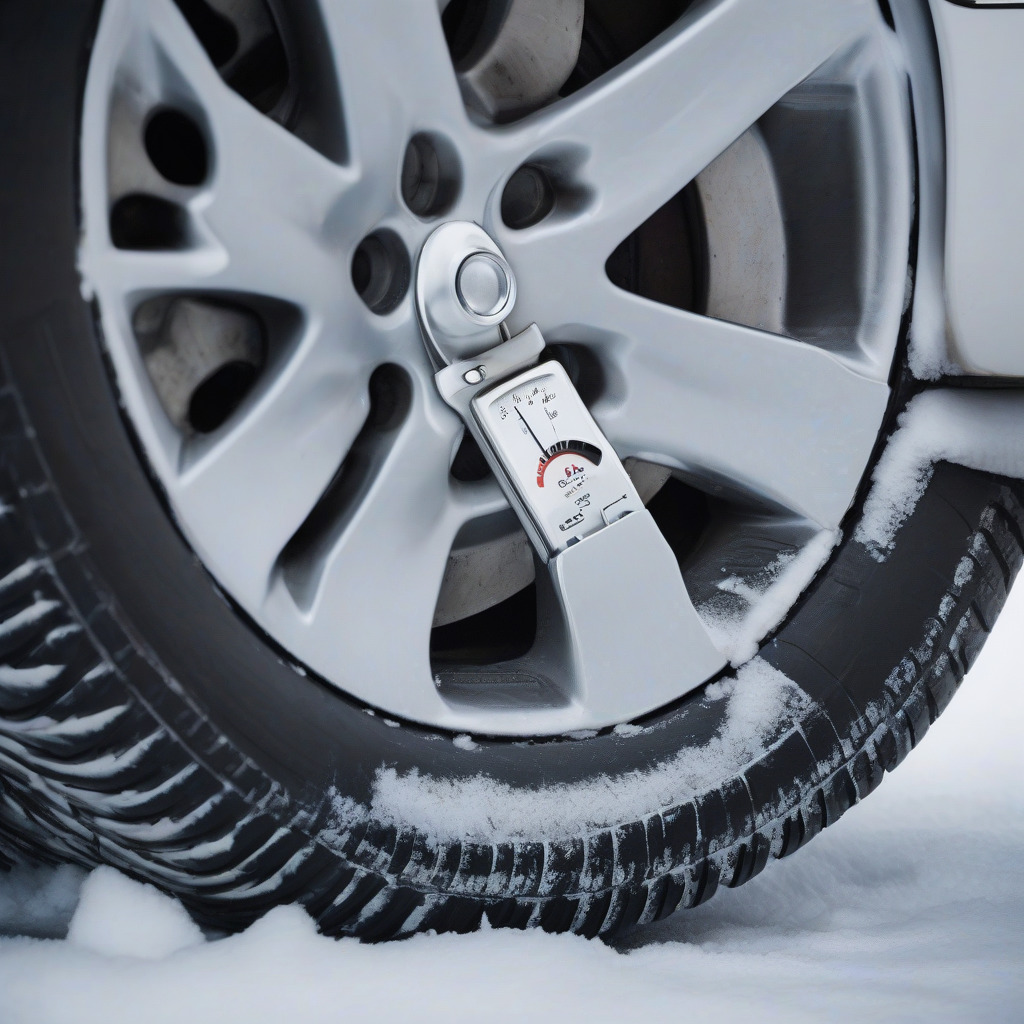
The fix is simple but requires a change of habit: check your tire pressure outdoors, in ambient Denver temperature, before departure. If your car’s been in a heated garage overnight, move it outside and let the tires equalize before checking PSI against the spec on your door jamb. Five minutes. It materially affects how your tires respond to the Eisenhower climb.
There’s a secondary issue for drivers doing the Vail Pass descent. At elevation, the thinner air above 10,000 feet is less efficient at carrying heat away from the tire surface. Drivers riding their brakes on the descent rather than using engine braking and low gear are building tire heat stress precisely when the grade demands the most from their rubber. Most people don’t think about this until they’re white-knuckling the Vail Pass descent. Think about it now instead.
A winter tire’s compound handles the temperature-driven PSI loss better than an all-season because it stays pliable even as inflation decreases — though no tire performs well underinflated by multiple PSI. Check pressure outdoors before you leave Denver. Recheck at the Eisenhower rest area if you’re heading further west.
What Denver Shops Are Recommending This Season
Sizes sell out faster than most people expect once the first real storm hits, so confirm current availability with your shop before committing. That said, the same names come up consistently across Denver-area shops this season.
The Bridgestone Blizzak WS90 is the volume leader for passenger cars and smaller crossovers. Broadly available, well-tested in Colorado conditions, and it handles the variable surfaces that define I-70 — packed snow to wet asphalt to glare ice within a few miles. Manages those transitions better than most comparably priced options.
The Michelin X-Ice Snow comes up when customers specify best-available regardless of price. Its braking distances on ice rank among the shortest in independent testing, and its siping pattern suits I-70’s variable conditions well. For drivers who’ve had genuinely frightening experiences with all-seasons in earlier seasons, this is the tire that most often restores confidence. Whether that’s worth the price premium over the Blizzak is a judgment call, but shops don’t steer people away from it.
The Nokian Hakkapeliitta R5 is engineered for Arctic conditions — actual Finland-in-January conditions. For most Front Range drivers heading to Breckenridge on ski weekends, that’s significant overkill. But for anyone making regular runs to Steamboat or the Western Slope, the performance margin is real. Availability in Denver is more limited than the Bridgestone or Michelin options; build in lead time if you’re going this direction.
The Continental WinterContact SI is increasingly cited for drivers of European vehicles where platform-specific fit and tuning matter.
On the all-weather side, the Michelin CrossClimate2 is the dominant recommendation for drivers who want 3PMSF compliance year-round without the cost and logistics of a second wheel set. It carries the snowflake certification, meaning it satisfies Code 15 and Code 16. It is not a dedicated winter tire — shops say this clearly — but it handles snow and ice well and is legal under Colorado’s traction law in any conditions. The Goodyear Assurance WeatherReady is the main alternative; the General AltiMAX 365AW is the value option in that category.
The performance gap between a dedicated winter tire and the CrossClimate2 is real but manageable for drivers who make the I-70 run occasionally. The gap between a CrossClimate2 and a standard all-season at 20°F is a different thing entirely — dramatic, measurable, and not a close comparison. Keep those two questions separate when you’re making the decision.
The Real Cost Comparison
Denver drivers are typically choosing between three options. Here’s what each actually costs over time, not just on the invoice.
Dedicated winter tires on a second steel wheel set. For a typical midsize crossover, expect roughly $700 to $950 for four mid-range winter tires (Blizzak WS90, common size like 225/65R17), mounted on steel wheels, balanced, and ready to install. Pricing has been volatile since 2021, so get a current shop quote before budgeting. Seasonal swap fees at most Denver shops run $60 to $100. Storage at a shop runs $50 to $120 per set per season — relevant for condo and apartment dwellers who don’t have a garage corner to stack a second set of wheels. The hidden upside: each set wears only half the year. Over four or five years, the cost differential versus a single all-weather set narrows considerably, which the sticker price obscures.
All-weather upgrade (CrossClimate2 or equivalent). Four CrossClimate2 tires installed on the same crossover runs approximately $900 to $1,200 depending on size, with no seasonal swap and no storage required. Year-round usability is the selling point. The trade-off is performance — a dedicated winter tire outperforms the CrossClimate2 on ice and hardpack, and anyone who skis regularly will notice the difference after their first real powder day. For drivers heading up once or twice a season, the CrossClimate2 is a rational call and provides full legal compliance. For drivers up every weekend December through March, dedicated winters earn their keep.
Doing nothing. The fine exposure is up to $650. Less visible is what happens when CDOT closes Eisenhower-Johnson Tunnel in severe conditions — the diversion runs over Loveland Pass on US-6. A driver who was already marginal for the tunnel approach is in a genuinely dangerous situation on Loveland Pass. The cost calculus here doesn’t favor inaction.
Where on I-70 Your Tires Actually Matter
Morrison/C-470 interchange (milepost 259) is where the traction law activates and where you find your last easy opportunity to check tire pressure before committing to the climb. If you haven’t done your verification work before merging onto the westbound lanes, you’re already past the optimal decision point.
Floyd Hill, west of Morrison, is the first real grade challenge and the first high-incident zone. Westbound climbing lanes carry heavy ski traffic on Friday evenings and Saturday mornings — anyone who’s tried to leave Denver at 6 p.m. on a powder Friday knows what it looks like. Eastbound, the descent toward Denver is where under-equipped drivers returning from ski weekends get into trouble. Tired from a day on the mountain, sometimes driving in the dark, on a grade that drops quickly toward the Front Range. Most preventable incidents on the corridor happen here.
Georgetown/Silver Plume is the traditional chain-up zone and the last practical stop before the Eisenhower approach grades. If you haven’t verified your tire situation by Georgetown, you are out of good options. Infrastructure is in place here — chains can be installed, and a turnaround decision can still be made without serious consequences. Beyond this point, your equipment choices are locked in.
Eisenhower-Johnson Tunnel (11,158 feet) has westbound approach grades of 6 to 7 percent, above-treeline wind exposure, and weather that does not behave predictably. This is where the PSI loss from Denver ambient temperature has fully materialized. The margin for error is narrow.
Vail Pass (summit 10,662 feet) has its own microclimate — blowing snow and icy conditions even when lower elevations are clear. The westbound descent is the final test of your tire choice before you reach Beaver Creek and Summit County. Tire heat stress from hard braking on a sustained descent is real, and the altitude makes it worse. Pay attention here even if the road looks clean.
The Denver Driver’s Pre-Mountain Checklist
Run through this before any November through April departure heading west on I-70.
Verify your tire certification and tread depth. Look at the sidewall for the Three-Peak Mountain Snowflake — mountain outline, snowflake inside. M+S alone doesn’t satisfy Code 15 or Code 16. Check tread depth; Colorado requires a minimum of 3/16 inch. If you’re near that threshold, your braking is already compromised regardless of legal compliance. Do this before you leave your driveway, not in the Morrison pull-off.
Check cold PSI outdoors before departure. If your car’s been in a heated garage, move it outside before checking pressure. Use the placard on your driver’s door jamb — not the number on the tire sidewall, which is the maximum, not the spec. Budget for 3 to 6 PSI of potential loss between Denver and Eisenhower Tunnel.
Check traction law status immediately before departure. COtrip.org has a live map. The 511 system has the same by phone. Conditions and enforcement codes can change while you’re driving. Knowing the status when you leave doesn’t mean you’re set for the day — if you’re delayed more than an hour between checking and actually leaving, check again.
Know the Georgetown chain-up zone. Chains can be installed at the chain station near Silver Plume before the Eisenhower approach. CDOT patrol enforces chain requirements actively during Code 16 conditions.
Know what tunnel closure means. If CDOT closes Eisenhower-Johnson, the standard diversion is US-6 over Loveland Pass. Non-compliant tires in active weather on Loveland Pass is not a situation you want. If COtrip shows the tunnel closed or under a closure advisory before you leave, make the go/no-go decision from Denver.
The annual pattern at Denver tire shops is consistent: October through early November, customers who procrastinated show up urgently after the first real Front Range snowfall and face appointment backlogs and limited inventory in popular sizes. Every year, without fail. If you’re reading this in October, schedule now. If you’re reading it mid-season, the checklist above tells you whether your current setup gets you on the mountain legally and safely. If the answer is no, finding out on Floyd Hill costs considerably more than fixing it beforehand — in ways that go well beyond the fine.