Denver's Inversion Season Is Coming. Here's What to Do If You Have Asthma, COPD, or Heart Disease.
National Jewish Health physicians explain the condition-specific protocols you need in place before the brown cloud settles in — and why your AQI app is undercounting the risk.

National Jewish Health physicians explain the condition-specific protocols you need in place before the brown cloud settles in — and why your AQI app is undercounting the risk.
If you have asthma, COPD, or heart disease and you live in Denver, October is not a month to wait. Inversion season is already beginning. The worst events land between November and February — the ones that stack particulate matter in a visible brown band over the metro, trap vehicle exhaust and wood smoke in the South Platte valley, and send vulnerable residents to emergency rooms. Peak severity hits in December and January. The time to have a plan is now, not when you can already smell the air on your morning walk.
This guide is not a general inversion explainer. It’s condition-specific clinical guidance sourced from National Jewish Health, the nationally ranked respiratory hospital on East Colfax and Colorado Boulevard. What follows covers what asthma patients should do differently than COPD patients, why Denver’s altitude changes the meaning of every AQI number on your phone, which home air filtration strategies actually reduce PM2.5 in a forced-air Colorado home, and what mistakes Denver patients make every year that put them in crisis when the brown cloud settles.
Why October Is the Last Window to Prepare
Denver’s temperature inversions work like a lid. Normally, air near the ground is warmer than air above, and pollutants rise and disperse. During a winter inversion, the pattern flips: a layer of warm air traps cold, dense air at the surface. The Front Range topography makes it worse. Mountains to the west block westerly airflow. Cold air pools in the urban bowl between the foothills and the eastern plains, stagnating for days.
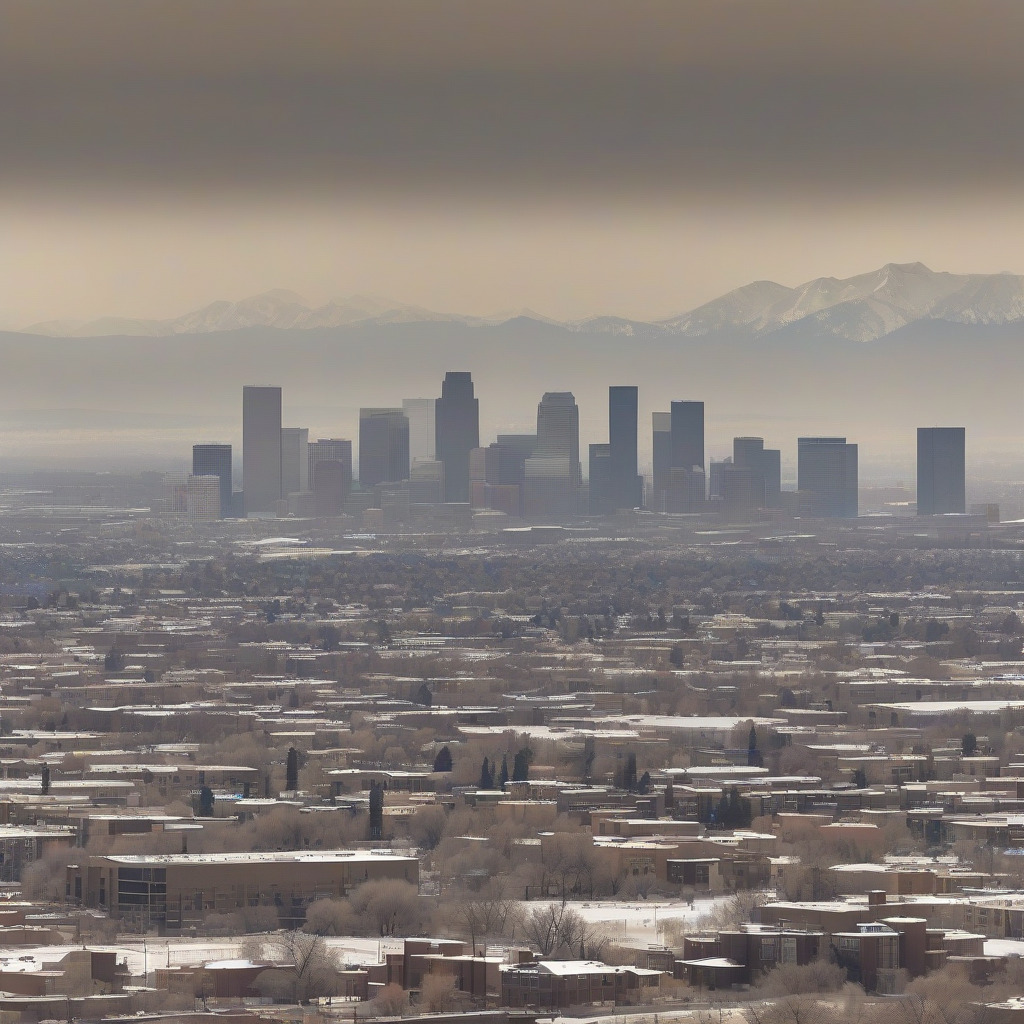
The result is the brown cloud — a phenomenon Denver residents of a certain age remember as an unavoidable fact of winter, now returning with growing regularity as the metro’s population and vehicle miles have climbed. On bad days it’s visible from I-70 heading into the city, or from Red Rocks looking east. PM2.5 — fine particulate matter small enough to penetrate deep lung tissue and enter the bloodstream — is the primary hazard during winter inversions. The EPA’s 24-hour PM2.5 standard is 35 micrograms per cubic meter. Denver regularly exceeds this during extended inversion events. Summer inversions produce elevated ozone instead, a different chemical threat that requires a different clinical response.
Refilling prescriptions, upgrading furnace filters, and scheduling pulmonary or cardiology appointments all take days or weeks. Do them now. Patients who wait until the first extended bad-air event find that pharmacies are overloaded, physician offices have tripled call volumes, and the margin for error has collapsed. Every year this happens. Every year it’s preventable.
Denver’s Altitude Makes the AQI Number Misleading
At 5,280 feet, Denver’s atmospheric pressure is roughly 17 percent lower than at sea level. There are simply fewer air molecules — including oxygen — in every breath. A healthy, acclimatized Denver resident typically maintains blood oxygen saturation of 95 to 96 percent, compared to 98 to 99 percent for a healthy adult at sea level. That’s not dangerous for a healthy person, but it represents a meaningful reduction in physiological reserve. You’re already working with less runway.
The AQI number your phone displays is calculated in micrograms of pollutant per cubic meter of air. It does not adjust for altitude. When Denver’s AQI reads 105, the absolute PM2.5 concentration may be identical to what a Boston resident sees at AQI 105. The Denver resident with asthma or COPD, however, is absorbing that particulate load with lungs already working harder to extract sufficient oxygen from thinner air. The baseline is lower. The margin to absorb additional insult is narrower.
The EPA’s sensitive-group threshold — the point at which people with asthma, lung disease, or heart disease should limit prolonged outdoor exertion — is AQI 101, the bottom of the orange “Unhealthy for Sensitive Groups” band. Denver pulmonologists working with patients who already have compromised function at altitude apply more conservative thresholds in practice. The specific number should come from your own physician, calibrated to your lung function and disease severity. A national color chart built for sea level is a starting point. It is not a verdict.
The Denver-Specific AQI Conversation You Need to Have With Your Doctor
What isn’t yet established, in any formal published protocol, is the exact AQI number at which Denver physicians advise their most vulnerable patients to stay indoors. CDPHE has not codified an altitude-adjusted threshold. Clinical practice determines it, patient by patient, based on disease severity, current lung function, and individual exertion demands.
The conversation to have with your pulmonologist or cardiologist this month is not “what does the EPA say?” Ask instead: “Given my diagnosis, my current lung function, and Denver’s altitude, what AQI number should trigger my indoor protocol?” Write that number into your action plan. If your written action plan doesn’t reference air quality at all, that’s the first item to address.
For reference: 0–50 is Good; 51–100 is Moderate; 101–150 is Unhealthy for Sensitive Groups; 151–200 is Unhealthy for all; 201–300 is Very Unhealthy; 301+ is Hazardous. Denver physicians may advise thresholds below 101 for patients with moderate-to-severe disease. Get your threshold from your physician, in writing, before November.
Cardiac patients face a different clinical picture — and it’s one that doesn’t get discussed nearly enough. The mechanism of harm from PM2.5 in cardiovascular disease is not primarily bronchospasm; it’s systemic inflammation and platelet aggregation. Fine particulate absorbed through the lungs and into the bloodstream promotes clotting and vascular inflammation, which are documented risks for patients with coronary artery disease, heart failure, or arrhythmia. The air quality conversation with your cardiologist is as important as the one with your pulmonologist, and the response protocols will differ.
Winter PM2.5 inversions and summer ozone inversions also require different responses. Ozone peaks in the afternoon on hot days with high sunlight and low wind — morning outdoor activity is safer for ozone-sensitive patients. For a fuller look at how Denver’s ozone season affects physical activity planning, our outdoor exercise guidance for poor air quality days covers that specific scenario in detail. Winter PM2.5 can peak overnight and in early morning when cold air pools at the surface. Checking AQI once in the morning and assuming you’re covered is how people get caught off guard. Check it at multiple points throughout the day.
The Denver Neighborhoods That Sit in the Pollution Trap
Not all Denver zip codes experience inversions equally.
Globeville, Swansea, Cole, and Sun Valley sit in low-elevation sections of the South Platte River valley, bounded by the I-25/I-70 interchange — one of the busiest freight corridors in the region. During inversions, cold air drains into these low-lying areas and stagnates. Vehicle exhaust, diesel truck emissions from the interchange, and industrial emissions from facilities in the corridor concentrate at ground level. These neighborhoods carry CDPHE environmental justice designations because of their disproportionate pollution exposure. The I-70 expansion through Swansea and Cole was litigated in part over air quality impacts on residents. During inversions, PM2.5 concentrations in Globeville and Swansea run meaningfully higher than the metro-area AQI number suggests, because that metro number is an average across monitoring stations spread across a wide geography. If you live in one of these neighborhoods and have a respiratory or cardiac condition, the gap between your actual exposure and what AirNow shows you is not trivial.
By contrast, Congress Park, Park Hill, and Capitol Hill sit at slightly higher elevations on Denver’s eastern plateau. The brown cloud settles over the entire metro, but ground-level concentrations are typically less severe than in the river valley.
CDPHE operates fixed monitoring stations at specific locations, but large portions of the city rely on interpolated estimates rather than direct measurement. If you live in a neighborhood without a fixed station, the AQI number on AirNow.gov is a modeled estimate. Denver Public Health can tell you which stations are nearest your neighborhood; reach them at 720-865-5401.
What National Jewish Health Tells Its Patients to Do Before a Bad Air Day Hits
The most important word is “before.” The patients who struggle most during inversion events are those who wait until the air is already bad to act.
For asthma patients, whether to step up controller inhaler dosing ahead of a forecasted bad-air stretch depends on individual action plan parameters set by your pulmonologist. This is not a unilateral decision. The question to settle with your doctor now is whether your written asthma action plan includes an AQI trigger. If it does, what is that threshold? Physicians commonly advise patients to confirm a full rescue bronchodilator — a fresh albuterol inhaler — before inversion season begins. Do not wait. During a multi-day event, pharmacy response times slow and you will wish you had staged that refill in October.
COPD patients on long-acting bronchodilators should confirm with their pulmonologist whether a short-course corticosteroid prescription is part of their action plan for exacerbation prevention. Some patients have a standing prescription filled in advance; some have authorization to access one during an inversion event. Some National Jewish Health pulmonary rehab patients have AQI-linked exercise modification protocols written into their rehabilitation plans — specifying at what AQI level outdoor exercise moves indoors entirely, and at what level intensity should be reduced. If you’re in pulmonary rehab or have completed it, ask your coordinator whether your program has inversion-specific modifications.
Cardiac patients need a distinct conversation with their cardiologist before inversion season — one that addresses PM2.5’s documented role in cardiovascular events. Patients on antiplatelet therapy, anticoagulants, or with recent stent placement or heart failure hospitalization should specifically ask whether their management plan addresses air quality triggers. Cardiologists at National Jewish Health and Denver Health are increasingly familiar with this question. If your provider isn’t, that’s worth knowing, and may warrant a consultation with someone who specializes in environmental cardiology.
For between-visit questions during inversion events, call National Jewish Health’s main line at 303-398-1234. They can direct you to the appropriate clinical contact without requiring an emergency department visit. And if you need same-day evaluation during a flare, our urgent care options for Denver weekends covers facilities that can assess respiratory symptoms without ER pricing.
The Monitoring Tools Worth Using and How to Get Alerts Before an Event
The best inversion preparation is not reactive. Denver residents with chronic conditions should be getting notifications before air quality deteriorates, not checking an app after they’ve already spent an hour outside.
CDPHE offers free email and text notifications for air quality action days, wood-burning restriction declarations, and ozone alerts. Search “CDPHE air quality notifications” for the current sign-up portal. When CDPHE declares an “Action Day,” it’s a formal recommendation that sensitive groups limit outdoor exertion. Wood-burning restriction declarations carry legal weight.
AirNow.gov is the EPA’s official real-time AQI map, pulling from CDPHE’s fixed monitoring network. It’s accurate for the locations it covers. Remember the interpolation caveat for unmonitored neighborhoods.
PurpleAir operates a network of low-cost consumer sensors that provides neighborhood-level readings between official monitor locations. Hyperlocal variation shows up clearly this way — the difference between a reading near the I-25/I-70 interchange and a reading eight blocks away can be striking. Low-cost optical sensors can overestimate PM2.5 without a correction factor applied. AirNow now incorporates a correction factor for PurpleAir sensors displayed on its map. Use AirNow-corrected PurpleAir data, not the raw sensor readings.
IQAir.com shows Denver historical AQI data by day, useful for tracking inversion season patterns year over year and for gauging whether this winter is shaping up as particularly severe or mild.
Wind forecasts are an underused inversion proxy. Denver inversions break when wind increases and vertical mixing resumes. A forecast for calm winds, light drainage flow, and overnight lows well below freezing — with a high-pressure system parked over the region — reliably signals that the next morning’s AQI will rise. A forecast calling for sustained westerlies signals conditions unfavorable for inversion formation. Check the forecast the evening before. It takes thirty seconds and tells you as much as any app.
Air Purifiers and Home Filtration — What Actually Works in a Denver Home
Denver’s housing stock creates a specific filtration problem. Most homes and apartments heat with forced air, meaning the furnace fan continuously recirculates indoor air. If the furnace filter is a standard 1-inch fiberglass panel — the cheapest option at any hardware store — it captures large dust particles and protects the furnace equipment. It does virtually nothing for PM2.5.
The most underrated and cost-effective upgrade available to Denver homeowners is replacing that filter with a MERV-13 rated furnace filter. MERV-13 filters capture particles in the size class that includes PM2.5 at meaningful efficiency rates. They’re widely available — Federal Boulevard Home Depot and the Colorado Mills Lowe’s both carry standard sizes for around $20 to $35. Check your furnace manual or the slot dimensions before purchasing. Some older systems aren’t designed for the higher resistance of a MERV-13 and may need a professional assessment first. For most modern forced-air systems, the upgrade is straightforward and provides whole-home filtration benefit during every heating cycle. During inversion season, replace the filter monthly rather than quarterly.
For portable air purifiers — appropriate for bedrooms, home offices, or apartment units without central forced air — the correct sizing metric is CADR (Clean Air Delivery Rate), not the square footage claims on the box. CADR measures how quickly a unit filters a specific volume of air for smoke, dust, and pollen. True HEPA filtration captures 99.97 percent of particles at 0.3 microns. Units marketed as “HEPA-type” or “HEPA-style” do not meet this standard. Avoid them.
The Coway AP-1512HH (“Mighty”) runs around $100 and has a strong track record for rooms within its rated coverage area. The Blueair Blue Pure 211+ runs $250 to $300 and suits larger Denver living rooms or open floor plans better. For patients with severe disease, the IQAir HealthPro Plus — $900 and up — delivers the highest filtration performance and is used in some clinical settings. Regardless of price, prioritize CADR-rated true HEPA units. That said: the MERV-13 furnace filter upgrade is frequently more impactful than any portable unit for residents with central heat. It’s also about a tenth of the price.
One more Denver-specific factor: metro winter relative humidity typically runs between 20 and 30 percent. Dry airways are more vulnerable to particulate irritation. A cool-mist humidifier used in the bedroom overnight — confirmed with your physician, particularly for COPD patients where humidification recommendations vary — may address airway dryness alongside filtration.
The Mistakes Denver Patients Make Most
Relying on a surgical mask outdoors during PM2.5 events is a widespread misunderstanding. A surgical mask filters large droplets. It doesn’t filter PM2.5 — the seal isn’t tight enough and the filtration layer isn’t rated for fine particulate. It provides negligible protection during a high-PM2.5 inversion. If you must go outside during a PM2.5 event, an N95 or KN95 respirator, fitted with no significant gaps at the nose bridge or cheeks, provides meaningful filtration. For patients with severe COPD or heart failure, the increased breathing resistance of an N95 may itself be a concern. Ask your physician before assuming it’s the right choice for your situation.
Burning wood on days that aren’t formally restricted adds directly to the neighborhood PM2.5 load. CDPHE issues wood-burning restrictions when PM2.5 or ozone is forecast to exceed certain thresholds, and those restrictions carry fines. But by the time CDPHE has declared one, the air is already degraded. Burning wood on any calm, cold night with light winds during inversion season — restriction or not — is directly breathed by neighbors with asthma and COPD who have nowhere else to go. That’s the reality of it.
Waiting until an inversion event to refill prescriptions is the most common and most preventable mistake. During a multi-day bad-air event, pharmacy wait times increase and physician offices are fielding high call volumes. The patient who needs an emergency albuterol refill is competing with everyone else who also waited. Confirm your fills in October.
Finally, a genuinely strange visual deception that catches Denver residents every year: when a temperature inversion is at its most intense, the smog layer sits below the inversion lid, which may be only a few hundred feet above ground. Above that lid, the sky can be brilliant and clear. Standing at street level and looking up, the day appears beautiful. Residents feel fine, see blue sky, and go for their run. The pollution is at ground level, where they’re breathing. That crisp-looking winter morning can be one of the worst air days of the year.
Your Pre-Season Checklist for October
These actions are sequenced by priority and can all be completed before November.
Medical:
- Schedule a pulmonary or cardiology appointment this month to update your written action plan with a specific AQI trigger calibrated to Denver’s altitude and your disease severity. If you don’t have a written action plan, request one.
- Confirm that your rescue bronchodilator prescription is filled and that the inhaler is not expired or nearly empty.
- Ask your physician explicitly whether a pre-season controller step-up protocol or a standing corticosteroid prescription (COPD patients) is appropriate for your case.
- If you use home oxygen or a nebulizer, confirm the equipment is functioning and supplies are stocked.
- Save National Jewish Health’s main line — 303-398-1234 — in your phone for between-visit questions during inversion events.
Home:
- Replace your furnace filter with a MERV-13 before the heating season begins. Set a monthly calendar reminder to replace it through February.
- If you use a portable air purifier, confirm it has true HEPA filtration and run it in the rooms where you sleep and spend the most time.
- If your home has a fireplace, make the decision now about whether you’ll burn wood this winter. Voluntary restraint on calm cold nights — even without a formal restriction — is directly consequential to neighbors with lung disease.
Monitoring:
- Sign up for CDPHE air quality email or text alerts. Search “CDPHE air quality notifications” for the current enrollment portal.
- Bookmark AirNow.gov for real-time metro AQI.
- Check PurpleAir’s coverage in your neighborhood. If there are few or no sensors near you, you’re relying on interpolated data.
- Call Denver Public Health at 720-865-5401 to ask which CDPHE monitoring stations are nearest your neighborhood and whether your area has direct measurement or modeled data.
- Learn to read the National Weather Service wind forecast as an inversion proxy. Calm winds, high pressure, overnight lows well below freezing: check your AQI the next morning.
The brown cloud comes every year, sits over the metro for days at a time, and sends a measurable number of Denver residents to emergency rooms. Most of those visits are preventable. October is the window. Use it.
For more local coverage, explore our Health & Wellness section.