How to Exercise Outside in Denver When the Air Quality Is Bad
Denver has been in violation of federal ozone standards for years. Here is a step-by-step decision tool for runners, cyclists, and hikers, built from local monitoring data and Front Range meteorology.


Denver has been in violation of federal ozone standards for years. Here is a step-by-step decision tool for runners, cyclists, and hikers, built from local monitoring data and Front Range meteorology.
The short answer: it depends on which pollutant is driving the number, what time it is, where you’re running, and how hard you’re working.
That’s genuinely more complicated than what most national health sites give you — and the stakes are real. Denver isn’t occasionally nudging federal air limits. The metro is in official EPA nonattainment for the 2015 ozone standard of 70 parts per billion. That means the region has chronically failed to protect residents from a pollutant that damages lung tissue, reduces aerobic capacity, and worsens asthma and cardiovascular disease. The Brown Cloud isn’t a quirk of mountain geography. It’s a documented public health problem, and it has been for a long time.
What follows is a six-step decision tool built from Colorado Department of Public Health and Environment monitoring data, Front Range meteorological patterns, and guidance from physicians at National Jewish Health (1400 Jackson St.) — the country’s leading respiratory research hospital, which happens to be located right here in Denver. Work through it before your next summer workout.
Step 1: Check the Right Number Before You Leave the House
The EPA’s Air Quality Index translates pollutant concentrations into a 0–500 scale with color-coded thresholds most people have seen: green (Good) through yellow, orange, red, and worse. Standard guidance says healthy adults can exercise outdoors through the orange zone. For Denver, that standard guidance may be too permissive.
The reason is ventilation rate. Running or riding hard at 5,280 feet requires more oxygen per unit of effort than at sea level, which means you’re breathing faster and deeper than a sea-level athlete covering the same distance at the same effort. More breathing per mile means more ozone pulled into your airways. Pulmonologists at National Jewish Health who work in the environmental and occupational medicine division have argued that healthy Denver runners and cyclists should treat an AQI of 100 as the functional “move indoors” threshold — not waiting for orange at 101. [Note to editor: a named physician quote from NJH’s Division of Environmental and Occupational Health Sciences is required before publication to support this specific threshold recommendation.] The national chart wasn’t calibrated for high-altitude aerobic athletes.
Before every outdoor workout from May through September, check two sources:
- AirNow (airnow.gov or the AirNow app): current and forecast AQI by ZIP code, broken out by pollutant. Look at which pollutant is driving the number — ozone or PM2.5. Your response differs depending on the answer (more on this in Step 6).
- CDPHE’s EnviroFlash (enviroflash.info): a free email and text alert service that notifies you when CDPHE forecasts a high-ozone or high-particle day for your area. Set it up once. It’s specific to Colorado air sheds and removes the daily habit of remembering to check.
Use both the night before if you’re planning an early run. Forecast data is available in advance.
Step 2: Schedule Your Workout Around Denver’s Ozone Clock
Ozone isn’t emitted from a tailpipe. It forms when nitrogen oxides (NOx) and volatile organic compounds (VOCs) from vehicles and industry cook in sunlight. That chemistry has a time signature, and in Denver it follows a consistent pattern.
Ozone peaks across metro monitoring stations between roughly 2 p.m. and 7 p.m. MDT on high-ozone days. Readings before 10 a.m. are reliably the lowest of the day. Most national health content ignores why — but the Front Range meteorology is specific enough to be worth understanding.
Denver sits at the foot of the Rockies. During summer, the mountains heat faster than the plains, driving a mountain-valley wind circulation that pushes air — including ozone precursors accumulated over the metro — eastward across the plains in the afternoon. The dispersion is initially helpful. The complication is what happens next: as mountain slopes cool in early evening, that circulation can reverse, pushing ozone-laden air back toward the metro. CDPHE monitoring stations have historically captured that recirculation signature in elevated late-afternoon and early-evening readings, which is why the peak window runs as late as 7 p.m. rather than ending at 4 or 5. [Note to editor: 2021–2024 hourly CDPHE AQS portal data by Denver monitoring station needed to confirm whether post-COVID traffic pattern shifts have changed this window; verify at colorado.gov/airquality before publication.]
On any June-through-September day when the forecast AQI tops 80, get your workout done before 10 a.m. A 6 a.m. run on a day that will hit AQI 120 by mid-afternoon is meaningfully safer than a 5 p.m. run on the same day. This is the single most impactful change a Denver exerciser can make, and it costs nothing.
Step 3: Know Your Neighborhood’s Baseline Risk
Not all Denver ZIP codes breathe the same air.
Commerce City, Globeville, and the Elyria-Swansea corridor carry the highest risk for exercisers on high-ozone days. The Suncor Energy refinery and the concentrated truck traffic around the I-70/I-25 interchange together create the highest NOx and VOC precursor load in the metro. On a day when central Denver hits AQI 95, Commerce City and Globeville can run meaningfully higher. [Note to editor: June–August 2023 daily max 8-hour ozone readings from the Commerce City CDPHE monitoring station versus the Denver downtown and Camp NRTC stations should be pulled from the CDPHE AQS data portal and inserted as specific ppb comparisons. General characterization is not sufficient for this claim.]
The I-25 corridor south through Englewood is elevated too. So is the South Platte River trail system during afternoon hours — and this one matters because the South Platte path is one of Denver’s most popular cycling and running routes. It’s a good trail. But on a high-ozone afternoon, it runs directly alongside the highway corridor where precursors accumulate. The 2-to-6 p.m. window on an Ozone Action Day is a bad time to be on it. West Denver neighborhoods within Suncor’s emissions influence zone face a similar dynamic when winds carry the plume east and southeast, though this shifts with wind direction and is harder to predict consistently.
Washington Park, Cheesman Park, and City Park sit away from the highest precursor concentrations. Early morning workouts in these parks carry lower risk on elevated-ozone days. Not zero — but lower, and the difference is real. [Note to editor: current active CDPHE monitoring station list should be verified at colorado.gov/airquality before publication.]
Step 4: The Altitude Doesn’t Help You Here
Denver’s elevation comes up constantly in running conversations, usually as a training advantage. On ozone days, it’s more complicated — and it doesn’t cut the way most people assume.
Atmospheric ozone concentrations are modestly lower at 5,280 feet because there’s less air pressure compressing the column above you. An AQI of 95 in Denver technically means slightly fewer ozone molecules per cubic meter than an AQI of 95 in Houston. That sounds reassuring. It isn’t, really.
To sustain the same aerobic effort at altitude, Denver runners breathe at higher ventilation rates — more breaths per minute, deeper breaths, more total air volume moving across lung tissue per mile. The ozone dose your airways receive is a function of both concentration and how much air you’re actually moving through your lungs. When ventilation rate rises to compensate for thinner air, it offsets the modest concentration advantage, and may exceed it.
The research on ozone exposure specifically at altitude isn’t as developed as the sea-level literature. The interaction between high-altitude ventilation and ozone dose per workout is understudied relative to Denver’s actual situation. National Jewish Health’s location here — and its ongoing work in environmental pulmonology — makes it the obvious institution to ask. [Note to editor: an on-record interview with a named NJH pulmonologist from the environmental or occupational medicine division is required before this section is fully sourced. NJH’s main number is 303-388-4461; media inquiries through njhealth.org.]
Until that research catches up: don’t treat a Denver AQI of 85 as equivalent to a sea-level AQI of 85. They may deliver comparable or worse ozone doses to your airways depending on your fitness level and how hard you’re working. The altitude is not your friend on ozone days.
Step 5: What an Ozone Action Day Actually Means
CDPHE issues an Ozone Action Day when its forecast models predict ozone will exceed 70 ppb — the same threshold at which the metro is out of federal compliance. It’s a public health communication tool, not a legal restriction on anything.
For people with asthma, heart disease, or other respiratory and cardiovascular conditions — and for children and older adults — the recommendation is to avoid prolonged outdoor exertion entirely on these days. For healthy adults doing vigorous exercise, an Action Day designation is your clearest signal to apply the full set of mitigations here: get out before 10 a.m., move to a lower-risk neighborhood, reduce intensity if you go out at all.
One thing that tends to get buried: because Denver is in nonattainment, Ozone Action Days aren’t rare disruptions the way a blizzard or a heat emergency is. Denver exercisers who treat them as exceptions consistently get caught flat-footed. The better approach is to build the mitigation habits into your weekly routine from Memorial Day onward and relax them after Labor Day. That’s not pessimism about the city’s air quality trajectory — it’s just an accurate read of where the problem stands right now.
[Note to editor: Denver Parks & Recreation should be contacted via 311 or directly at dprd.denver.gov to confirm whether outdoor fitness facilities — outdoor gyms, pool areas, recreation center outdoor spaces — are closed on Ozone Action Days. This is a direct service question that affects residents who rely on those spaces and deserves a specific answer before publication.]
Step 6: Don’t Confuse Smoke Days With Ozone Days
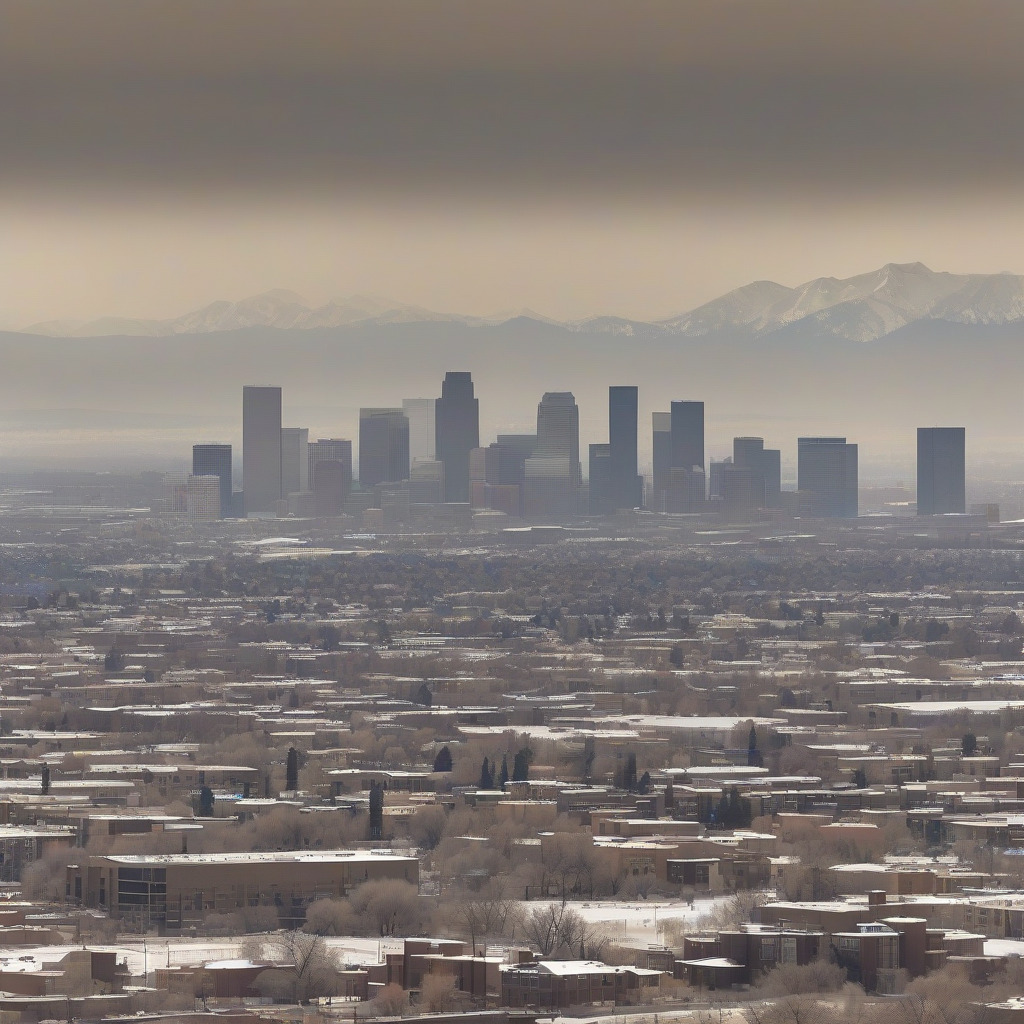
Denver has had an increasing number of days in recent summers when the air turns orange, the mountains disappear, and everyone’s eyes burn. Most people check the AQI, see a red number, and apply the same response they’d use for an ozone day. That’s a mistake — an understandable one, but a mistake.
The pollutant matters. Smoke days and ozone days are different problems that require different responses.
When wildfire smoke is driving the AQI, the culprit is PM2.5 — fine particulate matter small enough to lodge in lung tissue. A properly fitted N95 respirator filters out a meaningful percentage of PM2.5. Wearing one during a lower-intensity outdoor workout on a smoke day is a real harm reduction strategy for people who can’t avoid going out. It doesn’t eliminate exposure, but it reduces the particle load reaching your airways.
On a high-ozone day, masking does nothing. Ozone is a gas. It passes through cloth masks, surgical masks, and N95s with no meaningful reduction. Someone running with a mask on a pure ozone day has made themselves less comfortable without reducing their ozone exposure at all. The only effective ozone mitigations are behavioral: move to morning, avoid high-precursor zones, reduce intensity, or take it indoors.
The complication is that both conditions can occur at the same time. Wildfire smoke contains VOCs that contribute to ozone formation, meaning a smoke event can worsen ground-level ozone rather than simply add to it. On a dual-pollutant day, an N95 provides partial protection against the particulate piece and zero protection against the ozone piece.
The only way to know what’s actually driving the alert is to look at the pollutant breakdown on AirNow — not just the overall color. That breakdown is on both the app and the website. One extra tap. Check it on any marginal day.
Is Denver’s Ozone Problem Getting Better?
The honest answer is: not on a timeline that affects your summer workouts.
The Denver metro and the broader Front Range have been in nonattainment for the 2015 ozone standard since EPA finalized it. CDPHE has a State Implementation Plan — a required roadmap to compliance — but getting there has proven persistently difficult. A significant chunk of the NOx and VOC precursors that form ozone over Denver originates outside the metro’s regulatory reach, which limits how much local controls alone can accomplish.
Wildfire smoke has added a new wrinkle. As western fire seasons have run longer and heavier, the Denver metro has seen additional ozone precursor input from smoke events — a feedback loop that CDPHE air quality modelers have flagged as a growing problem in the State Implementation Plan context. It wasn’t a significant variable when the original compliance modeling was done.
Build the ozone decision habits in this guide into your permanent summer routine: check the number, check the pollutant, schedule for morning, know your neighborhood. Treat any eventual improvement in the metro’s attainment status as a bonus rather than something to plan around.
CityDesk Denver will update this guide when the named-source reporting noted above — NJH physician interview, CDPHE monitoring station data pull, Denver Parks & Recreation confirmation — is complete. Readers who want to dig into station-level data directly can access CDPHE’s air quality data portal at colorado.gov/airquality.